See more articles, reviews, fiction and poetry, including more of my writings, at group blog PLUTO'S REALM.

Monday, April 02, 2007

Thursday, March 22, 2007

Fundamental Alchemy

That's Ed and Al and Scar, some of the main characters from Fullmetal Alchemist, one of my favorite anime series. I've often regretted the absence of an anime presence on this blog, because it's become important to me and is one of my main joys these days; if you were to examine my Netflix cue, a good two-thirds of it is anime. I haven't done any blogging on anime because it's very hard to talk about to people who've never really experienced it, kind of like zazen; people walk around talking about it with no real understanding at all. But if you want to watch some good intelligent anime, this series is a really excellent place to start.

In fact, I think for the most part this blog grossly understates the value in my life of really good fiction; I'm dying to talk about some of my favorite fiction writers, especially William Gibson and Kathe Koja. But those articles are going to take a little time, and I just wanted to spit out this thought that's been occurring to me through the wee hours of this morning while the rest of you are sleeping, and Fullmetal expresses it as well as anything: the Principle of Equivalent Exchange, the fundamental law of alchemy.

Alchemy has really gotten a bum rap. It is of course, a false science and a myth. But it was the primary obsession of Isaac Newton's life (there are some great history pieces on this, none of which I feel like digging up at the moment, but for a fascinating historical fiction treatment, read the best fiction epic series of the last ten years, read Neil Stephenson's Baroque Cycle) and the driving force behind the creation of chemistry and modern science. And compared to some of the other really stupid things people believe these days, alchemy is a real prince of a belief system. Most people think of alchemy as the attempt to turn base metals into gold, but it ultimately was a quest to turn the base metal of humanity into eternal life, in line with another familiar myth of the last two millenia. And it has some very basic and true premises, the most fundamental one being the law of equivalent exchange; the fact that for everything taken something must be given, and that for everything gained, something is lost. Ed and Al forget this when they try to bring back the dead. Most of us forget it every second of our lifes.

If you went to high school back when they used to teach science there, you should remember from first-year Chemistry the necessity of balancing chemical equations. In every chemical reaction, you must have the same amount of stuff (or stuff plus energy, when you get a little further in) on one side of the equation as the other, or before and after. This comes from alchemy and is a fundamental rule of existence. Isaac Newton knew it, Einstein knew it, why don't you know it?

You may think you do but you don't. It comes down to what Brad Warner (and every other decent Zen teacher, but I just like Brad's style) keeps saying; the fundamental delusion and cause of suffering in human life is the desire to end suffering, to get to that next stage where one little thing is fixed, so that everything will be better and you will live happily everafter. You probably know that with your mind, but you don't live that way; it's the not the fundamental color of your mind from second to second. You just think, if I could get that girl, if I could get that job, if I had that car, if I just didn't have cancer of heart disease or gout everything would be perfect. You know better? No, you don't.

It occurred to me many years ago, that no matter what my circumstances were, and by extrapolation your circumstances, I was going to be happy and unhappy about the same amounts of times. Live as a rock star has its ups and downs, as does life as a prisoner. Some of the best times I've had, subjectively, were in the best parts of some of the worst circumstances. It's got more to do with your brain chemistry than with your external circumstances. One of the most basic things I've come to realize in the last couple of years is that nothing is going to make things better on a personal subjective level, and nothing is going to make things worse. You just think they will.

"Nothing is better, nothing is best. Take care of yourself, get plenty of rest." - Bob Dylan and the Band, the Basement Tapes.

And that from my point of view on this Thursday morning has everything to do with living our lives as they are, not as they wish we were. It's all perfect because it's all there is, and it's the only way it could be. The fundamental cause of unhappiness is the quest for happiness. But you can make yourself happy in this moment. Go watch some good anime.

Sunday, March 18, 2007

The Whole Beast

I've been reading and commenting on Brad Warner's last article on the Suicide Girls sight. If you haven't checked out his stuff written for that site, you should do so; it may seem like an odd place for a Zen teacher to be posting, but it fits in quite well, and if anything I think I like his articles there even more than the ones written for his regular blog, probably because on Suicide Girls he's writing less for insiders. You don't have to be a member of the site to read the articles, and there's a link to it in my directory to the right.

Anway, in the latest article, Brad writes of how the recent death of his mother led him to look at his place in the world and his responsbility to it differently, and to appreciate the value of each moment of life. When my mother died almost four years ago, I fell apart and went crazy for a while, but when I came back to myself a year later, I felt the need to define myself in a new way. As long as your mother lives, you have a mediator between yourself and reality, but with her death, you face the great unknown head-on for the first time, and it becomes necessary to do so clearly. In my case, it led me back through various forms of Buddhism to Zen, which as you all know by now is where I started in about 1981.

I always have a dissonance with all the Buddhist writers who talk about Zen or Buddhism as a way of saving the world. First, as my friend Gareth has pointed out, Zen will never be a majority religion in the country, and I think that the reason for this is most of the Zen teachers in America, as opposed to what has happened at various times in its long history in Japan, have tried to keep it pretty true and honest, avoid all the mythologizing and devotionalism that tend to inflate popular religions and make them acceptible to the masses. I'm not against the other branches of Buddhism, mind you, but I think that for the most part they are what Buddhists talk about as skillful means, or as I might rephrase it, expedient means.

The only way to get to a real understanding of Zen is to burn out all of the shortcuts and easy answers that your brain will try to give you on the way to an understanding of the truth. I try not to talk about Zen too much (except for its history and a listing of my activities) because it ultimately can't be talked about; words always fail, by definition. The only truly accurate map of the world is a the world itself, but we have to have less accurate maps because the world is hard to fold up and put in the glove compartment. John Dewey's discussion of mistaking maps for territories was one of the valuable things I brought out of my undergraduate education in psychology into my adult worldview. This is how all the books and speeches on Zen compare to the real thing.

So in other words, I think the people who have come to Zen in America are the people who have come through the games of philosophy with its ulimate message: that the mind is limited and cannot grasp reality. They have come through conventional religion and seen that it is a delusion. If Zen were taught to everyone, if it were a mass religion, it would have a lot of deluded adherents. Maybe I'd feel differently if I liked in California or somewhere with a lot more Buddhists; there are fools in every crowd.

My point to all this is that the completion to my understand and acceptance of where I stand in relation to the universe came when Jim Lydecker began hitting me with his Peak Oil stuff. Oh, and The Omnivore's Dilemma was the other part that completed the whole. Realising the influence of petroleum and post-WW II surplusses in ammonium nitrate on the modern food industry, one finally has grasped enough parts of the elephant's body to realize what the whole beast looks like.

And what it looks like is the end of civilization. We are already in the beginning of the Oil Wars, and I believe we will never see peace again. In pursuit of the Carter doctrine that the U.S. is willing to go to war for oil, with no intention of reducing our consumption, we will have to fight the rest of the world for the rest of our lives to feed the burgeoning monster that is America. And it's not just us; the rest of the world will have to do the same. In one sense, the Bible-thumpers will be vindicated; the End Times are coming, and I think those in my generation will see by the end how lucky we will be not to see them through to their own bitter end.

I tend to agree with the thesis of Tom Brokaw's book The Greatest Generation, that my parents' generation, who grew up in the Great Depression, fought and won WW II and turned America into the greatest power in the World, was the greatest American generation. It appears also that they drove the final nails in the coffin of world civilization, although they did so with the best of intentions. Ironically, I think it will the revolution in food production which occurred in the forties, fifties, and continues, which will be the death knell of humankind. Peak Oil has always been inevitable, but it is the mindless and ridiculous expansion of human population, which Paul Ehrlich pointed out in The Population Bomb in 1971, resulting from literally forcing food out of the ground with petroleum fertilizers, which have made it occur within our lifetimes. Maybe fifty years ago civilization could have been redirected in a way to let us and our children and maybe the next generation lead decent lives, but it's too late now. Life for children born now will be hell by the time they are middle-aged.

And there's not much you can do it; if it makes you feel good to try to save the world, by all means do so. Jim is still upset up the end of the world; I'm not. The same human drives and human nature that build civilization have led it to its almost inevitable end. I accept that, and I thank Zen for that acceptance. No, Zen is not fatalism. In my case, it is the tool that enables me to perceive clearly and apply what I feel is appropriate effort to the world around me. I would like to promote Buddhism, and ultimately, Zen, as my own particular kind of compassion; I feel it is a tool that may enable those about to walk into hell to endure it as well as possible. And none of your delusions will help you with the walk through hell.

Tuesday, March 06, 2007

Shawna Potter and AVEC


This video was included in my last post as a link, but for those of you too lazy to check it out, I've put it front and center here; when I found it, I was just looking for anything featuring Shawna Potter, formerly of Fair Verona, here with AVEC, but I frankly didn't expect to find anything this good. My question is, why hasn't everybody found this?

As I understand it, AVEC is formed of Texans who have relocated to Baltimore, for whatever bizarre reason. Personally, my acquaintance with this band came through my being a fan of Shawna Potter, through her first band, Fair Verona (the links are in the previous entry, people). Fair Verona was a victim of a combination of young musician innocence in contract-signing and corporate greed, and had to cease to exist, much to the dismay of Nashville rock fans. The members went their separate ways. I have no idea what happened to Leah, the bass player; maybe Shawna will fill me in. Beth is now in a band called Forget Cassettes, a band I'd truly like to forget (Shawna tells me they just had a bad night the one time I saw them, and they're apparently making it big, relatively speaking, so what do I know?). Shawna linked up with AVEC and moved to Baltimore, and at first I didn't think the band was a good enough showcase for her talent. Apparently I was wrong, or the band has gotten better.

A lot of things have gone wrong in America in this century, more bad news than I could have thought would happen in six years. An evil moron has been elected President twice, by evil moronic people. America is on the road to becoming a totalitarian state, although some slight resistance has arisen (too late?). But the music! Listening to pop radio is now a Hellish experience, almost worse than TV. I listen to NPR or jazz radio or my IPOD linked through the cassette deck.

In the late 90's, rock was on its way to becoming the best it's ever been, largely due to the female influence. Prominent on my IPOD are Julianna Hatfield and the Blake Babies, Bif Naked, and lots of others I don't want to digress into at this point. I went to the first two Lillith Fairs, being one of about 5 percent of males in the audience. One more digression: if you've never seen Shawn Colvin perform live, you've missed out on what acoustic live music should be. As Stan Lee would say, 'Nuff said.

Anyway, that was probably the milieu that gave birth to Fair Verona, and I'm glad it did. When I saw them live, I was drawn to the voice, guitar and sheer persona of Shawna Potter. I think Shawna was 17 when the band started, the youngest of them. When I saw her play, I swear I saw the future of rock and roll. I still think that. Who was to know that rock and roll had no future? The music on the radio is shit, and if I sound like an old fart saying this, let me say that I have no stomach for "classic rock" either. My music in the early seventies was Bob Dylan, John Lennon, David Bowie, T. Rex, Mott the Hoople; when punk broke, it was Elvis Costello, the Clash, the Sex Pistols, the Ramones. The eighties was a long dry period, but when the new rock era broke in the 90's I thought there was hope. But the vapid slush that composes pop music today is in keeping with the times -- hopeless and doomed.

So, when you find a band like AVEC, support them. Follow the link; they're very hard to Google, because you get every French site ever put up. Buy their CD's and when they come to your town, go see them, support them. Shawna says they're gonna be touring this summer or fall behind a new album: I'll post or link to the schedule. Go see the alternative present of rock and roll. This is the world you should be living in.

Friday, March 02, 2007

DIY

No, this post is not about this band, as interesting as it is. The band I guess is called Nouvelle Vague, and according to their website, is a group put together by some French guy to do these cocktail-lounge version of what they call post-punk music. You gotta love their version of "Guns of Brixton." This version of the Dead Kennedys' "Too Drunk to Fuck" was the most refreshing thing I found on You Tube yesterday, so I thought you had to see.

I guess this kind of relates to the point of the post, which is that I saw American Hardcore last night, and it's a great documentary. Brad Warner reviewed it in his blog last year, and did a damned good job of it, which he should, since this is his millieu, not mine; for those of you who haven't read even the into blurb on his site (first, shame on you), he was the bass player for ODFx, an Ohio hardcore band, long before he was a Zen web pundit. But this is not my music. My era was earlier; I loved all the pre-punk bands, especially the original punks who started the whole thing, the New York Dolls. Seeing them last year here in Nashville, even with only two original members, completed my concert-going experience. The Nashville "alt-rock' scene was fairly interesting a few years ago, with bands like Fair Verona around to demonstrate that a (then)17-year old girl like Shawna Potter can riff with anybody; although I'm admittedly out of touch now, except for Be Your Own Pet, who are not to be missed and rarely grace Nashville with their presence anymore, I don't see anything else that holds up.

Anyway. I find the music in American Hardcore barely listenable, but I gave it five stars on Netflix because the movie was so inspiring. The story of Hardcore music, the bastard stepchild born when punk died and morphed into New Wave around 1980, is the story of punk all over again; young kids with no money, no connections and only moderate (at best) musical talent, doing their own thing, with no hope of transcending their environment. Dead end at its best. It was played with no publicity in mostly illicit venues throughout the country; the film puts its run at 1980- 1986. If you're 15, you get together with a bunch of your friends, misunderstood misfits who are learning to play their instruments onstage; you pick a good name, dress in whatever rags you can scrounge, rent the Ukranina polka club for the night, trash it, and then go find another innocent landlord and do it again. Advertising is flyers and word of mouth.

Some of the best of these bands, the Dead Kennedys (who started) earlier and the Circle Jerks were around in San Francisco when I was there 1980- '83, but I never saw them. Not my scene; I was too old in my early twenties, though I built up the nerve to brave what was left of this scene and its legacy years later when I was much older. I do remember the flyers, though, and the band names. The Snap-on Tools come to mind (this was San Francisco).

The flyers are key, though; the art was sometimes great. In one of the film's most revealing scenes, Keith from the Circle Jerks shows how the band hand-made the sleeves to its EP's, thousands of them in that pre-CD era. If you wanted to start a Hardcore band, there was no momma-poppa record company, no Svengali manager or agent; you booked your own venues, paid for your own bus trips (Henry Rollins discusses a two-show road tour with the Teen Idles), and did your own thing.

The inspiration for me in a movie like this, about a music movement which produced little if anything that was (to me) listenable, comes in its subtext message: Do It Yourself. Which is not so much, do your own work, but create your own thing, even if no one else listens to your music or understands or appreciates what you do. When I was young, I wrote and drew quite a lot of really bad comic books; later I wrote some decent songs and accompanied them with some fairly poor guitar playing. Lately, all this web stuff is strictly DIY on my end.

The point, is, it's your life and you'd better do what you want to do and do it now. I fail to stick with this even now, sometimes, even as I approach 50 and should know better. I am extremely dedicated to my Zen practice, and I love anime and I really like writing these blogs and trying to teach myself to build a website; I am quite attached to my cat and to my Rufi. I am extremely glad I never married or had children; I cherish my time alone. I don't like housecleaning, no matter what Zen says. What else do you want to know?

The mistake I make is in expecting anyone else I know to share any two of my affections. Most of the Zen community consist of affluent educated people who will never understand my musical tastes or my interest in anime, manga or cyberpunk (I apologize in advance to William Gibson for using that term, but I'm trying to be terse). I intentionally took myself out of the "professional" community a long time ago; most of the people I work with watch American Idol. Yesterday there was a huge in-house sale on cheap Prada sunglasses. Do you see?

So, the message of American Hardcore for me was: Do It Yourself. Build your own life, even if no one else wants it. I probably wouldn't want yours either, but for today, mine is exactly what I need.

Monday, February 26, 2007

Emptiness

I've been trying to get the top part of the background to this new blog template to turn black, hacking away at the html, but it stays pink regardless of my efforts. The Rufi are laughing.

Today had a sour start to it. Birds have covered my car with shit again, and there was no opportunity to wash it off. I'm still having trouble getting paid for all my collections at work. I still don't have an insurance card despite assurances, after almost five months of employment and four weeks of deductions. The more I learn about the websites I'm trying to build, the more frustrated I get.

The front of the duplex I'm renting is really ugly and getting worse. One of my old friends keeps borrowing minor sums of money and being really slow about returning them. It's frustrating trying to lose the weight I put on in a year or two of semi-involuntary lethargy. I worry about going to the doctor for the first time in years; what will he find? I constantly realize no one around me thinks at all like I do.

I have artistic visions I can't express; I don't have the talent. One of my favorite writers actually responded to my email. I wonder if my fellow Buddhists are making a mistake not being politically active, and whether I'm making the same mistake. I have visions of grinding metals and heat. I don't like all the thoughts that come through my head. I wonder if I'm crazy.
Sometimes I wonder if delusion is not better than seeing clearly, then I wonder if I know the difference. The United States is about to attack another country; no one is doing anything to stop it.

I cried when John Lennon was shot. He was my first hero.

This must be what blogs are like.

Friday, February 23, 2007

Whoops!

Due to some unfortunate early-morning fiddling around with the template, my links section and some of the add-on features have been deleted. We'll be paying some attention to that on Sunday.

Meanwhile, all the content of the blog entries is still here, so enjoy!

Sunday, February 11, 2007

Christiane F.

At various times throught a lifetime, one sees movies that change that life forever, and for me, this was one of them. It gave me a vision I'd never had before, and it's been with me since. I've been trying since yesterday to remember just where and when I saw this movie. It must have been in 1982 or 1983, when I was living in San Francisco, making occasional visits to Palo Alto to complete my law degree at Stanford, but mostly soaking up the ambience of the City itself; I remember how this films' incredible soundtrack inspired me to ride the Muni underground late at night with my cassette deck and headphones, listening to Bowie and Eno, looking at the other riders. Looking up the movie's history now on the internet, I see it was completed (in Germany) in 1981, released in theatres there in 1982, so probably only in a handful of US cities could I have seen the film, especially that early. Then I lost the film for years -- couldn't ever find it on VHS, or on DVD, until I randomly turned it up on a Neflix search last week, and had to have it immediately; the film pulled on me like heroin did on its young protagonist.

Christiane F.: Wir Kinder vom Bahnhof Zoo is a true story, ripped from the headlines of Berlin circa 1980. Its heroine is a 13- and 14-year-old girl who gets into drugs through the club scene, becomes addicted to heroin, and winds up as a train station prostitute. The film is ostensably an anti-drug movie, but the only redemption for the film's protagonist comes in a voice-over at the very end; the real message here is in the imagery. And the imagery is some of the most powerful, maybe the most powerful I've ever seen in a film. The soundtrack is David Bowie's best music, mostly from the Low and Heroes albums he produced with Brian Eno during one of his own druggie periods. The visuals are stunning, gritty yet cold, the lonely horror of the train stations, restrooms and Soviet-era block apartments set as background to the warmth and humanity of the characters. Amazingly, Natja Brockhorst, the actress who portrays Christiane and probably the most beautiful child actress I've ever seen, doesn't seem to have had that much of a career after, and is now working behind the cameras.

Although I searched for this film for years, I had no idea it had a cult following until I renewed my internet search; it looks like I am far from the only person whose life it touched. Yet when I try to reach into my head to tell you exactly how this movie affected me, I suffer from a rare loss of words. Certainly, the ethereal, haunting beauty of the film is memorable for a lifetime; yet many of its scenes are of stark depradation. In today's films, even the supposedly "hardcore" ones like Alpha Dog, drug use (except for marijuana) usually occurs off-screen; in Christiane F. is is explicit, in your face; it is the character's lives, and there is nothing glamorous about the way it is portrayed. As opposed even to later well-done drug movies like Spun, there is no humor here, no let-up; just sadness and warmth, icy cold and pragmatic reality.

So. I did not become a heroin addict after watching this movie; I did not move to Berlin. After all, this movie was about kids, and I was probably about 25 when I saw it. It did give me a new vision of cool, a kid with his or her head all smacked-out riding the subways. It took me years to figure out you can't get that head from drug use; it just comes from watching movies as good as this one. You can't groove on the beautiful Bowie soundtrack when you're jonesing for a hit, of heroin or anything.

So when I think of the image the film formed in my head of a cool junkie riding the subway through the night with Bowie in his ears, I realized that's an image that could never meet reality; only the voyeurs like me could do that. The real junkies were having an existence I wouldn't wish for you (unless you're in the Bush administration) on your worst stay. It think that maybe heroin addiction is such a powerful and compelling image for us because it is the distillation of essence of a life driven by desire and attachment. We are all, in a sense, junkies, wanting that perfect buzz we can never have it, and we don't all seek it from drugs. We seek it from money, power, sex and all the other cravings signified by all the obvious buzzwords and labels. And like junkies, we'll never lose that urge, but it's part of who were are; to steal the words of one of the biggest cults in operation today, we have to just deal with it, one day at a time.

[I'm writing this early on Sunday morning with a head full of sugar and caffeine, having made myself buckwheat pancakes for breakfast. Now here's a drug buzz I can live with and still work out later today. Find your own comfort zone.]

Oh, and by the way, this movie is available only in German or in English dub; I would have preferred to watch it in German with English subtitles. So much for the comfort zone.


Thursday, February 08, 2007

Zen Updates


I made it back to the Atlanta Soto Zen Center last weekend for the first time since last October; what used to be the monthy sesshin is now the zazenkai, to differentiate it from the longer events that happen now three times a year and has, counterintuitively, gotten longer; aspiring zazen-sters can now sit from Thursday evening through Sunday. This time the emphasis was on the minute details of Soto Zen ritual, which can be a bit much if you don't do them all the time, but which were interesting to me since most of the ritual is pretty much blown off here at the Nashville Zen Center.

The down side of the weekend was that the ASZC isn't heated properly, so the sleeping accomodations stayed right at 58 degrees, which if memory serves is the constant temperature of a cave, until Nat, who accompanied me, broke down and bought a $9.99 space heater at Eckert's the night before we left. The upside for me is that a record number of Nashvillians went with me: new NZC president Nat, who'd gone with me to my initiation in September, 2006, and Ana. Ana is probably the story of the retreat for me; she's a 19-year-old Zen student who's been sitting by herself or friends for a few years and who finally came to sit with us at the Barn the weekend before the zazenkai. To watch someone handle their first extended sitting, with minimal attendance and at adverse temperatures, as well as she did was inspiring, and a reassurance that you don't have to middle-aged to appreciate Zen. After listening to Nat whine all weekend, her fortitude was impressive. Here's hoping Ana stays in the practice; we need her.

Next on the menu: ASZC Abbot Taiun Michael Elliston returns to Nashville for a one-day zazenkai (no one else here is calling it that, but I like the term) on Feb. 24 at Jennye's mom's beautiful lake house north of Mount Juliet. Meanwhile, I've just joined the Board of the Nashville Buddhist Festival, a cooperative event put on by various schools of Nashville Buddhism set for Sept. 15. The event is supposed to be annual (this will be the fourth), though it was cancelled last year for various reasons. The Tibetan Buddhists who had been a mainstay of the event have pulled out, allegedly on the instruction of their teachers (?), so the event is apparently being hosted by us at the Barn as usual (a recent tidbit of knowledge which came to us a couple of weeks ago from an outside source, prompting our inquiry and my concommitent participation), being put on this time by the remaining Buddhist groups, including the Vipassana group, One Dharma (a non-sectarian group with Zen tendencies organized by previous NZC president Lisa Ernst), a Thich Nat Hanh group of which I had no prior knowledge, and us. I think there may be a Shambala-related Tibetan group in there somewhere, too. Anyway, it will be interesting to see how it comes off without the Tibetans, who always supplied the crowds.

A side note: There is an ongoing project involving some Theravadans (Southeast Asian Buddhists, I believe) who have acquired and have been working on renovating an old house near the Hood in downtown Nashville into what is being projected as a non-sectarian abode for the use of all Buddhists in the area. They have never been involved in a Buddhist Festival before, but now I am thinking.

Also, as of this date I am scheduled to host a "panel" on Zen at the Middle Tennessee Anime Convention on April 15, a seeming dubious venture, but I did it last year and met Ana, so if I have to unearth one Zen student at a time, it's worth it; hopefully Ana is helping me with the presentation. It's currently scheduled at 9:00 a.m. Sunday morning, prime time to be sure.

Also, I blithely write along in these posts without ever referring to my Links sections, which are just over there to the right, thinking that the additions would be pretty obvious, but I may be over-assuming the attention of my readers to these things; so I would just point out that I have re-organized the things a bit in the last few months, and also added some more Buddhist links and some personal sites of my friends: note particularly the blog of Shiho Gareth Young, a senior disciple at the ASZC, as well as that of Shokai, another ASZC student/teacher, and Ana's MySpace page, which has an ongoing blog as well. Check out the links; there are a few surprises there as well.

I'll be back with another thematic rant in due time. For those of you checking out the hyperlinks, which was half the point of this entry, some of the above have no web page. If I have missed anything, let me know.

Saturday, January 27, 2007

The Return of the Beast

Forget the Super Bowl. I'm sick of Peyton Manning, and whoever cared about the Bears with their pasty-faced prepubescent quarterback? No, the sports event for me in the opening months of any year is the Australian Open, played as usual this year in the middle of the Sydney summer, this time featuring players suffering on Day 2 with heat and dehydration while America digs out from a foreshadowing of the coming Long Winter. Of course the men's game suffers from the oppressive dominance of Roger Federer, whose friendly Swiss arrogance reminds me of vintage Hingis; but the women's game as usual provided the full panoply of personalities, which distilled down to the final with the World's Pin-up Maria Sharapova meeting American Gorilla Serena Williams in the final.

For me, a fan since the seventies, tennis has never had villains like the Williams sisters. Every sport needs a villain, but the entry of Venus and Serena onto the scene in the late 90's brought the WTA into the world of the WWF. Long after the Martina Navratilova and Chrissy era, and following upon the heels of Steffi Graf's long dominance, tennis prodigy Martina Hingis burst on the scene in 1997 at the age of 16, winning everything with the assurance of an undefeated child and possibly the best tennis mind of all time. Then, from the darkness which had given us Darth Vader in the previous generation and the New World Order in pro wrestling, emerged Richard Williams with his offensive progeny and his mission to prove that grace and intelligence meant nothing besides raw power and ghetto trash talk.

Richard Williams was the Don King of tennis. He nurtured his evil brood in some hidden compound somewhere; the Williams sisters were never allowed to compete in the juniors, gestating in some private hell while Hingis and Anna Kournikova were evolving toward the non-rivalry of the late 90's (said Hingis, in classic style, "What rivalry? I win all the matches."). Then first Venus, then Serena emerged to throw Hingis into mediocrity and despondency as brain yielded to brawn and the Sisters dominated for several years. They were hailed as the return of the great American tennis player, though what their trash talk and oppressive power had in common with Chris Evert's grace, I'll never know.

The Williams sisters, victims of their own success, began to languish a few years into the millenium. As usual with rich people with no culture, they flaunted their ignorance in a variety of ways, the most hilarious of which is Serena's entry into the field of fashion. Serena has the fashion sense, particulary with regard to color, of a technicolor hooker on meth (witness the black leather with studs look or the blue hoop earrings with the green head scarf last night. Sassy.). Sadly, no one rose to prominence in the sisters' decline, leaving us with the mediocrity of Amelie Mauresmo as temporary world number one. The field in women's tennis, decimated by the Williams dominance, became reminiscent of the seven dwarves era of the 1992 presidential campaign. But even as the dwarves ultimately gave us Bill Clinton, who may turn out to be the last rational President, the lukewarm broth of post-Williams tennis gave us Maria Sharapova, who at 17 kicked Serena's erratic ass at the 2004 Wimbledon in the greatest underdog victory since another 17-year-old named Boris Becker won the same tournament unseeded in 1985.

Sharapova at her best combines grace with beauty and power in an unprecedented manner that sports marketers had only dreamed of until her. Anna Kournikova actually was a rival to Hingis in the Girls game, but turned out to winless and unable to cope in the WTA, and whatever motivation she may have had to get her game on track was doubtless drained by her celebrity in spite of her lack of success, and her career as a model. Sharapova is the highest-paid women's athelete ever and only a fraction of that comes from her tennis success. She is the beautiful face of women's tennis, and has the skill to back it up. This year, with Justine Henin finally breaking up with her effeminate husband (was he a beard? dunno), Sharapova came into the Australian as the top seed, and does in fact emerge with the number one ranking, despite her ignominious loss last night (today, actually).

But Serena came back. I hesitate to say she is back; every since the Serena Slam of 2002-03, her career has been checkered by stops and starts, erratic performances, bizarre outfits and fits of ball-spraying, mixed with sheer exhibitions of power and yes, skill, like last night. Watching Serena curse Maria after Sharapova finally won a rally with a direct shot to Serena's body, watching Maria roll her eyes to the heavens as Serena's victory speech sank to the level of thanking all the little people, I can't think there's any love lost between these two, despite the respectful speeches belied by their facial expressions. Maria will come back to battle the darkness; may the Force be with her.

Saturday, January 20, 2007

Post-Oil Man

I sort of have mixed feelings about this guy, sent to me by Jim. The artist, whom I've never encountered before, is James W. Johnson. This guy is certainly a mild version of what's bound to be going on within the next century, but if it takes a cartoon to get people to understand or even be interested in what's right before their faces, so be it.


I was always fascinated by dystopias like Brave New World, 1984, Dhalgren, etc. Even the most illiterate of the population have seen Mad Max and its ilk; Dark Angel was one of my favorite series of the last great gasp of network TV at the turn of the century. The population of the post-apocalypse was always pretty much the same, the quality of its representation depending on the author, but the cause was always different.


The cause of the end of civilization as we know it is now apparent: overpopulation, as stimulated, aggravated and made possible by Peak Oil, soon to be dealt with the way nature has always dealt with excess; by massive war, famine, disease, misery and death. As optimistic as some of my fellows are, there is no way to straighten the situation out without unprecedented human suffering. Most of the earth's population will have to die off, and the time frame is too short for any kind of population management, which has been fought against by morons for several generations now until it's too late.

The point at this point is not to save humanity; it's to prepare oneself to deal with the inevitable. The efforts made by the guy in the video won't last him long, any more than hoarding and the most strenous efforts you can make now can prepare you for the worst. In the war of all against all, nothing can survive, not even the strongest and the fittest. It's a battle to see who starves last. The current Oil Wars are only the most obvious sign.


All my efforts the last few years just enable me to see more clearly, and I can't filter it with wishful thinking any more. Just enjoy the fact that we've seen the high point. All those Jetsonian future utopias will never happen; we're almost as hi-tech as we're gonna get. Yeah, we'll have niftier cell phones. But the real things that could've been done in the previous generation that could've considerably lengthened the arc of the curve of human culture -- such as population management, rational and conversative planning for the earth's energy future, and political realism -- weren't. And it's too late now.


Maybe this is one reason I've lightened up on the Bush Cabal and the neo-fascists these past months. It really doesn't matter. The Republican losses in the last election may or may not slow the descent into hell, but the brakes are made of cotton candy and the roller coaster is already on the downhill track. So hang on and prepare to hit bottom, probably within the lifetime of current generations.


Have a good weekend.


Sunday, January 14, 2007

Why I Miss the NSA


No, not the National Security Agency. I mean the Nichiren Shoshu of America. They don't exist under that name any more; they're now called the Soka Gakkai of America, probably since the mid-90's, and I understand they're a lot different these days. It really doesn't matter, since I quit my affiliation with them in 1988 and have no intention of going back. But at times when I find myself question my place in the Buddhist community and in the world, I find myself having fond memories of this organization, despite the apparent absurdity of its premise and practices and some other serious faults, certainly knew how to build a sangha and to help each member find his or her place in it.

In February, 1986, at the age of 28, I'd had enough of my life as it was and decided to make some changes. Without recapitulating my whole biography, I'd ridden myself into a dead end with a failed law practice I hated and nothing positive going on in my life. I was drinking way too much, and I was out of a job. Desiring just to change everything, I took one last look at my Scotch bottle and quit drinking; I didn't touch another drop of alcohol for five years, and during that time took a journey through previously unknown territories. Within a couple of weeks, my brain chemistry had completely changed and I began to wonder what else I could do that I'd been denying myself before. I joined a gym in Albuquerque and began working out seriously for the first time in my life. And still within that same month, I made a phone call to what turned out to be the Albuquerque headquarters of the Nichiren Shoshu of America, and pretty much completed the still unspoken formula alluded to in my previous entry for what turned out to be power in my personal life.

I'll save the rest of the formula for later. The point is for this blog that I started practicing Buddhism for the first time in about eight years, and really committed to it for the first time ever. I'd flirted with Zen in my readings and tangentially in practice during my years in California, starting at the San Francisco Zen Center, but I was, as I have said elsewhere, too young and too dissolute to stay with it. In that magical February, with these unknown wonderful and natural chemicals allowed to generate in my brain for the first time ever, I pulled out the phone book and began looking for Buddhism.

Just how I wound up with Nichiren Shoshu is sort of a puzzle to me. These days when I Google Buddhism in Albuquerque, I come up with every conceivable school. But it seems in memory all I could find listed at that time was some unpronounceable Southeast Asian (probably Theravadan) temple, and the NSA headquarters.

Most of the NSA's recruiting in those years was through the practice of shakubuku; basically they handed out pamphets, went door to door and out in the streets, dragged people to meetings like Moonies, and tried to get them to receive the Gohonzon. The Gohonzon, pictured above in a fairly nice butsudan, was the object of worship for Nichiren Shoshu.

OK, let me back up here. For some of you faithful readers, I've been here before. Nichiren Shoshu of America was the American branch of the Soka Gakkai, which was the lay organization of a branch of Japanese Buddhism known as Nichiren Shoshu. The Soka Gakkai was founded after WW II and had a powerful corollary political organization in Japan. The Soka Gakkai, and its American version, functioned in a fairly cultish way, and could actually be or have been a cult, depending on your definition. If it was a cult, it was a very benign one. I was with the NSA, or the SGA, from February, 1986, until August, 1988. I left because ultimately I rejected some of the more absurd underpinnings of the practice, but mostly because I felt smothered by the organization itself. I don't need to go into detail here; you can find all sorts of stuff on the internet on this subject, and if you want something fairly objective, just look at the links to Ryuei's stuff (to the right, kids). Anyway, somewhere around the early 90's, the priests excommunicated Soka Gakkai President Ikeda and the entire lay organization. But I was long gone.

Despite all the negativity about the NSA/SGA, they sure knew how to raise a sangha. First, of course, the organization was extremely hierarchical; the president of the NSA, a Japanese who had adopted the name George M. Williams, was just a flunky of Ikeda, and the everything flowed from there down like the best pyramids in Amway. The New Mexico headquarters was divided into I think three or four districts (and I believe I had risen to the level of a district leader when I quit). Each district was divided into hans, or groups. The hans were divided into junior hans. On a parallel note, the whole organization was divided into men's, women's, young men's and young women's divisions, so that for example each district had a men's leader (who was always the district leader; no gender equality here at that time), a women's division leader, etc. You get the idea.

I was as I said 28 when I joined. There were guys older than me in the young men's division, but I was kept in the men's probably because I was a practicing attorney (my practice having revived itself with all my other changes). My role, after the first few months, as a hansho (han leader) and then a district leader, was to lead the meetings. The meetings consisted of conducting gongyo, the twice-daily ceremony, followed by lots of chanting of nam-myoho-renge-kyo, which was then hopefully followed by a question and answer session for guests, who may have drifted by, been brought by a member, or shanghai-ed off the streets. So was a Buddhist leader, although of questionable vintage, involved in the propagation of Buddhism from about 1987 on. I found that I really enjoyed leading the meetings and answering the questions. I liked being entrusted with more and more responsibility and having people look to me for questions with their faith.

OK, so there was a lot of bullshit involved, too. The publications and ideology of the sect were frankly, embarrassing and often idiotic. How someone with my educational background and acquaintance with what I now consider to be more authentic schools of Buddhism could have stayed with the fundamental bullshit of the NSA for 2 1/2 years, is questionable, as I was fighting my mind the whole time. Just ask Ryuei Michael McCormick, now a Nichrien Shu priest and a Buddhist seeker who was with the NSA during this same period, about it sometime. The Philadelphia rally and the Freedom Bell. I really don't want to go there.

So, how could I have stayed? The answer was, I felt like I belonged. I had become just as disenfranchised in my own way as the people on the streets who were dragged into the meetings. But I had a ritual that framed my life and my practice and made it all worthwhile, and I think there is a real human need for that. I had a place to go every morning and every evening if I wanted to share that practice with others and didn't feel like chanting at home alone. I had responsibilities. I had an ersatz family with whom I shared a lot of time and a lot of common experiences.

Since my return to Buddhism and my ultimate return to Zen in the last few years, I fell that I have found the right practice for me. I have been formally inducted into Buddhist practice twice; most lately last September as documented on this blog, but the first time was in Albuquerque, New Mexico, in early 1986 when I received the Gonhonzon. I think I still have the thing in a drawer somewhere. I made the right choice when I left the NSA in 1988, and I very definitely made the right choice in committing to Zen. My problem has been in finding a sangha.

The Nashville Zen Center had its annual Board of Directors meeting the other day. I left feeling kind of sad. I am still a director of that organization, and I will continue to sit with them. These are the people who encouraged me when I first stuck my foot back in the Zen waters, and some of them have become my friends. But they have no teacher and seem content to stay exactly as they are: a group that sits on Saturday mornings and does little else. This all sounds very Zen I guess to lay people, but it doesn't give me the support I need for my personal practice. The Atlanta Soto Zen Center, on the other hand, where I have made my formal commitment, has the support and opportunities I need, at least to some extent and moreso that what I have here, but they're a long way away and I'm committed here, at least for now. I am strangely sad when I see their website and emails and all the things I can't participate in.

I try to do what I can. If anyone's interested, I'm doing a presentation and/or a Zen service of sorts for the Middle Tennesee Anime Convention in April, trying to bridge my love of Zen and anime, and hoping maybe without hope that some of the young people at the convention might be mature enough to develop a Zen practice. I'd really love to do a beginner's meeting on a regular basis, but I don't feel I have the support I need to do this.

No one reading this is going to have the answers to any of the questions or longings stated or unstated herein. I just wanted to get it down in writing (I almost said, on paper) and to express my nostalgia for a time when I felt responsible and needed in the context of Buddhism. I hope I didn't bore or alienate you. Wish me luck.

Thursday, January 11, 2007

My New Year Begins

I really love this picture; it's one of my best friends from one of my newer lives and one of the best (and few remaining) from one of my older ones. That's Robert and Stephanie (the names if not the stories should be familiar to readers of this blog) here in Nashville in early December, 2006. Robert just gave up his legal career for now and is heading down the Atlantic coast in a sailboat, believe it or not. Rarely do your friends from different lives become friends, if infrequent ones, and it's always somehow satisfying when it happens.

I had some interesting summing up of some of my lives at the end of 2006. Among other friends, I saw two old friends from those aforementioned previous lives; Robert, and my old friend Jim Lydecker, whom I hadn't seen in nineteen years. Readers will recognize he's the one I found on the internet, and whose writings and musings are not only accessible at points throughout this blog, but have filled in some of the gaps in my understanding of what exactly is going on with this civilization of ours. Robert and Jim both passed through Nashville for a night or two on their ways somewhere else, but it's always nice at the end of a year to have present physical reminders of some of the better aspects of the places and people you've been. It also really points out the differences between those places and where you are, and maybe helps you see where you need to go.

I've never really spelled out my little secret formula for being who I really like to be, as opposed to who I really am sometime, and this isn't the place for it, but when one ingredient is missing, it really leaves a chunk out of me. A couple of days after my birthday, I stepped on a tack that went right through the sole of my shoe and into the sole of my foot, and although I hobbled quite well and didn't get infected, it put the end to my working out for a few weeks, which got extended into a couple of months with the holidays and their consequent (though not inevitable) degradation of lifestyle. Anyway, I'd picked this week to pull myself out of my holiday slump and the last missing piece was the return of my exercise program.

Step aerobics. You heard it here. An odd and dying art, but one that helped pull me out of my really big slump in 1986 and helped make me the better parts of who I am today. And you can't do it with a hole in the bottom of your foot. Anyway, my program resumed last night and this morning I am reborn. Sore, of course, but that's part of it. I could feel toxics rushing from my body like Republicans scurrying from enlightenment. I slept like a baby last night and got up and hour early this morning just because I felt so good. I wanted to write you this blog so I could show you what good friends I have. I have very good intentions at this time.

So we'll see. There's always a chance for things to go wrong. But for right now, everything's right. My New Year has begun, a little delayed. I hope yours is a good one, too. Make hay while the sun shines; the darkness is a-comin'.

Saturday, December 23, 2006

Merry Christmas


Yep, that's Bif Naked to the left. If you haven't picked up on the Bif Naked listings in my links, or the hyperlinks hidden in some of the text, you may not know she's been one of my favorite artists since about 1995. Check out her site and her MySpace page; and soon I'll post the video for "Nothing Else Matters" which you've already heard on the "Celebration" blog entry. Plus, if you scroll to the bottom of the blog, there's another Bif video that's been there for a while.

Anyway, Merry Christmas. It seems like it's been a good year. I haven't heard a damn thing about the War on Christmas this year, which may be a sign that the liars who promulgated all that crap last year have been forced back on their heels and are having to deal with some of the real issues. Plus, I like Christmas, I really do. I have friends who don't, and it's true that all the "commercialization" can drive you nuts. I think what I really like is the real meaning of the holiday, which is the solstice and the Yule. This holiday is a lot older than Christianity, and any fool who thinks it's Jesus' birthday is just that. A year-ending (and beginning) holiday is something we should hang onto in this modern era.

And I say "Merry Christmas" to everybody. The one thing the Christians have right this time of year is that "Happy Holidays" is a bunch of crap. I mean, if you're Jewish and say "Happy Hanukah," that's great. Muslims have a holiday, and we Buddhists do too, and I'll return any greeting you give me. The only one that bugs me is that Kwanza crap; for Christ sake, don't make up a holiday, there's plenty of them already.

But I'm listening to Christmas music as I write this, and I'm looking forward to seeing my family for the next few days. I try to make my Christmas gifts minimal but interesting. I already gave the Rufi their Christmas; the little guys got a truck and HR got a cigar.

By the way, the best pop Christmas music of all time is probably Jethro Tull's Songs from the Wood album; click this link for a video. The best of course is all that great classical music written for this occasion. Talk to ya before then!

Merry Christmas.

Tuesday, December 19, 2006

Every Dog Has His Day

Sometimes things gotta work out right.

I don't really write a lot of good news in here; in fact, I don't write a lot of news at all. My cousin Phyllis wrote that she's been following my life through this blog, which made me think what an odd view of my life you'd get that way. I mean, I'm really not writing a newsletter. I didn't talk about my quitting my old job right after New Years last year though I did document my leisure time fairly well til I was forced back into the work place this summer; I didn't really talk about any of those jobs at all, since one of the main things I look for in a job these days is something I can forget about the minute I leave the office (although I like to be good at it while I'm there). I didn't talk really talk about the car wreck I had Oct. 9, although I really wanted to post a pic of the totalled car (I was too stressed in the search for another one that I forgot to take a picture). So you'd think that my life consisted of disjointed events and strong opinions. But I do feel compelled to let the other shoe drop on the Nashville Zen Center.

After all, you really had no autobiographical info in this blog at all until "The Empty Well" back in March, in which I chronicled what I perceived the sad state of aforesaid NZC and my frustration with it. You then followed my exploration trip to Atlanta, my discovery of the Atlanta Soto Zen Center, and my subsequent initiation into Soto Zen. So it really would be incomplete if I let 2006 end without reporting the culmination of all these events to date, in the visit of ASZC Abbot Michael Elliston and his senior student Gareth Young to the NZC.

Sometimes events just seem to be slapping at me randomly, like big bloody insects in the wind when I'm driving a motorcycle through the mountains at night. And then sometimes I reach a peaceful place where they all seem to form a coherent pattern like a movie or someone else's biography. I've been in the latter place the last few days, from which it seems as if my first bungled attempt to orchestrate a Zen event -- and yes, I now admit it was my lack of knowledge and preparation, and my insecurity and consequent unwillingness to take charge and responsibility of that NZC spring retreat that probably led to its objective failure (though I certainly got a lot out of it) -- was a necessary prequel and training for what was pretty much an unqualified success.

Succinctly, the teachers came, thirteen of us at the table (!) had dinner, then we had a very good sit, meet and talk the next morning. Nothing newsworthy here, except that the desire I've had to bring the authentic Soto spirit to Nashville finally paid off. The ASZC leaders were excited about Nashville, and quite a few of the NZC members, whose (in Ellistons's words) maturity of practice and diversity I've finally come to appreciate are desirous of further interaction with Atlanta. I'm planning another trip down in February, and Atlanta wants to come back here, too. Except for some group money I wasted in advertising, it couldn't have gone better.

See, there's nothing gritty for this blog when things go well. One more thing: I really haven't mentioned any of the Zen stuff in here recently, in fact since October. If you're wondering why, it's because I'm finding it harder to write about. More and more, it seems everything I read or hear about Zen, expressed in language is, well, not necessarily wrong, but not quite right. I sit every week after our NZC sits and listen to someone read from a Zen book, usually gritting my teeth (I hope not literally); the readings from Sunryu Suzuki or Thich Nat Hanh (especially) or whoever just seem -- off. I'm currently reading the copy of The Kyosaku, Vol. I of the Teaching Archives of Soyu Matsuoka Roshi, the teacher of Zenkai Taiun Michael Elliston which was inadvertently left at the Barn after the sit Saturday. It's a very good book, for a Zen book, and I'm putting off sending it home til after Christmas so I can read a bit of it until I can order my own copy through the ASZC website. I'm certainly enjoying it more than most Zen books. But it just seems more and more to me that writing about Zen, or teaching about it with words is like writing with a Sharpy on the side of an aluminum coffee pot; most of the words don't stick and what's left is blurry and vaguely wrong.

Hojo (Abbot) Elliston again pointed out Saturday that what people perceive as paradoxes in talk about Zen are only apparent paradoxes; in my own words, they point out the limits of the language, not a problem with Zen. Even here, I'm starting to smell that magic marker so I'll stop. To me the only reason of reading about Zen and talking about Zen is encouraging people to do Zazen; it seems to me from my limited development and understanding that everything comes from there. So the best Zen book is the one that gets you to do Zazen. The one that did it for me was Brad Warner's Hardcore Zen, which cut through all the academia and showed me that someone who thought a lot like me (though also very differently) could benefit from the practice, stripped of all its artifice. I just finished rereading that, and if you're of my generation or younger, and tired of the academic approach to phiosophy or the religious approach to "spirituality", it's still the best.

I feel the same way about Zen ritual; it's just a mostly enjoyable, aesthetically appealing framework for Zazen. I enjoy it. So whatever works, works.

Anyway, enough prattling on about things I've just admitted are not suitable objects of prattle. The Nashville Zen Center is doing just fine at the moment, thank you, and so am I.

Monday, December 11, 2006

More Chicks

It seems the Dixie Chicks are getting a little more respect these days, since a few people in this country have finally started realizing that we all should be ashamed that the President of the United States is not only from Texas, but from America at all. The song for which I posted the video a few months ago is now nominated for a Grammy, and even W.'s dad seems to be ashamed of him.

The movie for which the above is a trailer looks like it'll be worth seeing, for sure. It's not so much that I'm a huge fan of the Chicks' music, although I've always had a lot of respect for the quality of their musicianship, and especially Natalie Maines' incredible voice. Modern "country" has never been much other than music for the lowest common denominator, people who know nothing about music (especially real, authentic country) or about anything else. That's why so many of its stars are drug addicts and degenerates in cowboy hats; their fans are just so easily deceived. So why shouldn't they be easy dupes for the terrorist/fear hype of the Bush administration? In the face of this, the blacklisting of the Chicks after Ms. Maines' insightful, honest and just plain obvious comment was not surprising.

What should frighten you about the blacklisting of the Chicks is that it wasn't so much a government effort (although I'm sure there was some insidious support behind the fervor of ignorance that drove them off the charts) as a spontaneous ejaculation of hate and stupidity from the masses who propelled Kenny Chesney to fame. Fear, hatred and ignorance arise endlessly. How do we help the dregs of humanity prop their eyes open for the next fear campaign? I just don't know. The people burning the Chicks albums are a part of us, after all. Go deep and feel the hate.

I have to admit I haven't even heard all of the album. I understand the Chicks have moved further from country (which betrayed them like it's betrayed all of its real stars; ask Emmylou Harris). Let's just admire them for their courage and their being not ready to back down. We all could learn from it.

Let's face it, if you voted for George W. Bush the first time, you have the excuse of ignorance, but if you did it twice, you're a bad person and need to be punished. I think two years in one of Rumsfeld's prison camps, locked in a cell with Kenny Chesney and Tim McGraw would be appropriate.

Saturday, December 09, 2006

What's for Dinner? Part II


Having dined last night on way too much barbeque, I feel constrained to review part of my discussion of vegetarianism in the last entry. Last night's dinner and this morning's indigestion remind me of something that occurred to me a few months ago, not for the first time: For the most part, the less meat I eat the better I feel. Looking back at the last entry, I feel I may have seemed hostile to vegetarianism, which I'm not at all. I'm very pro-vegetarian. Really, some of my best friends are vegetarians.

I admitted I wrote that last one fast, and there were some poor word choices, one of which was, rather than saying vegetarianism was a form of escapism, it would have been more appropriate to say it was a form of idealism. That's only if you're a vegetarian because you are opposed to the inherent cruelty to animals in meat-eating. I certainly understand the position, and as I said, I think we are all a little repulsed by the actuality of the process, or we should be if we are not insensitive to the plight of other creatures. Of course, that's the slippery slope, and knowing what I know about the factory dairy and egg industries, the philosophical position of the lacto-ovo-vegetarian doesn't make a whole lot of sense. It's pretty clear that more cruelty is inflicted on laying hens, especially, than the chickens we eat; in short, the chickens we eat, as abused as they are, are treated much better than their egg-laying sisters because if they were as ill-treated as the laying hens, we wouldn't eat them. It's that bad. So to me, if I were going to be a philosophical vegetarian, it's vegan or nothing.

Of course there's a whole other school of vegetarianism which has nothing to do with animal rights, and is not idealistic at all but pragmatic. It's the school that refuses to eat meat because of health reasons. Especially this morning I am empathetic to this school. I said in the last entry that I thought it was clear that a little meat every now and then is healthier, and there is no doubt that man evolved as a meat-eater (and probably never would have evolved to his present exalted state without it). Without outstanding success as a predator, man never would have had the leisure time to develop agriculture, which was the foundation of modern civilization. So you see it all works together. And we shouldn't forget that all domestic species now raised for food co-evolved with man in a symbiotic relationship. Nevertheless, it's a perfectly valid question whether we need to eat all that meat anymore.

I think it's pretty clear we don't. In an extremely inactive society, we just don't need that much meat. Of course our modern diet is a mess, as best illustrated by the sad plight of the current generation of obese children. Remembering just how few fat kids there were in my childhood, as compared to now, we are indeed in the middle of an "epidemic" as that word is now loosely used. Of course it also appears (to me, again) that the culprit in child obesity is not meat, but a combination of lack of exercise and more importantly the infusion into our children's diets of massive amounts of high-fructose corn syrup (which incidentally never appeared before 1980). So that's a whole other discussion, also very much covered in Pollan's book.

But nevertheless, it appears that a much more suitable diet for today's bovine society would be a diet of whole grains and cruciferous vegetables. It certainly would be better for our digestive systems. The most disgusting twist in food fadism in recent years was the whole Atkins Diet insanity, which thankfully has faded a bit. Of course I did personally witness people losing a lot of weight on this nutball regimen, but hey kids, anorexia and bilemia will work for the same purpose, with similar results -- starvation. Especially with my guts full of flesh and hot sauce, the idea of a nation of fat people stuffing themselves with nothing but meat leads me to images of their digestive tracts from which I am rapidly retreating.

My personal experience is that when I am happy and healthy and getting good exercise and my brain chemisty is firing well, the less meat I eat, the better I feel. When I have been sick or hung over or in some other form debilitated, nothing brings me back faster than meat. So for me meat is like medicine. It is best used sparingly. So find your own level, but give those grains and vegetables a shot.

And then there's our friend the pig (the one who's not currently trying to fight his way through my intestines). After part I, Kate sent me an email which included the following:

I disagree, again, that there's no middle ground between animals "being okay" as in not suffering at all and "being okay" as in not being raised in factory farms or bred solely to be eaten. A similar dilemma with the middle ground between saving the world and offering your actions in a positive way, however small.

That's part of a mini-debate we have over social activism; I think we agree on most principles, but I'm just more cynical. I agree that each person doing what he or she can in every small way as it appears will make the world a better place, and there's no doubt it will make better people of those who act thus accordingly with their compassion, which is what is really essential, since I think civilization and man are going inexorably down the tubes, we are past the point of no return, and there's nothing more important than how you ride.

My response, again in part, was:

We're 100% in agreement on the factory farms. I'm saying that a steer (or a heiffer, for that matter) who's raised on a small farm has a good life until he's killed and eaten, as long as he's fed on grass. Otherwise he wouldn't live at all. Remember these cattle were pretty much created by us (as was the bison, really) from much different animals, for our benefit, and they have co-evolved and adapted with us. The bottom line question is, is is better for them not to live at all, or to live (on a good farm) then die mercifully. They're not going to live in the wild (which would be horrible for them anyway) or be pets (most of them) or gain citizenship. So it's a good farm life, followed by slaughter, or nothing.

And:

The next thought to hit me was, the cattle are actually about the least of the abuses. By far the worst treated (although they're all living in a big animal Guanatanamo) are the laying hens. The chickens we eat, bad as it is, are treated better than the ones that produce the eggs. They can't move at all. And when they're about to die, the lights are turned out and they are given no food or water to force out a few more eggs. I'm going to try to find some farm-raised eggs and chicken.

The only relief to the above is that having lived among poultry, my empathy for them is pretty limited. Not so with hogs. Hogs are smarter than dogs, in my opinion. If we want to stop abusing higher animals, we should start with not eating pork, like a lot of other people in the world. It would make more sense to torture your dog than to raise a hog in a factory farm. Incidentally, these are the one domesticated food creature that could make it in the wild, so a Free the Pigs movement would be the most coherent of all (although you sure would wipe out some ecologies!).


There I go quoting myself because I'm too lazy to rewrite. I'm trying to review the history of the hog, and the internet isn't cooperating with me much this morning, but I do know that hogs are not native to America, having been introduced by the Spanish, who just turned them loose into the woods to be hunted as needed. Whereas cattle are totally domesticated (and again, this is a fascinating section of Pollan's book), hogs are little changed from their progenitors and are in a way just really smart wild animals who are our captives and victims. Surely, surely, we could give up eating them. I surely could at this moment. Posted by Picasa

Wednesday, December 06, 2006

What's for Dinner? Part I


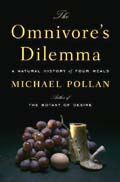
One of the topics I've been wanting to take on since I started this blog is the matter of diet - what to eat. I've been dancing around it and avoiding it and deciding I'm not quite ready to write it because the topic is just so damn huge. I just can't see any way to handle it in one blog entry. It may not seem so big to you in view of some of the things I've taken on in here, but I've probably spent as much time in my life thinking about what to eat as just about anything, and I have at least thirty years' worth of thoughts on the topic trying to organize themselves out of the spin cycle in my head -- hence the title of the book I just read by Michael Pollan, The Omnivores' Dilemma.

I'm not going to really try to review the book as there are hundreds of good reviews of it out there; thanks for the recommendation, Phyllis. The compelling part of this book is that the author comes at the issue of proper diet not through some didactic premise, i.e. vegetarianism or veganism, but the simple open question of, What am I to eat? Because no matter what your moral commitments are, Man is an omnivore and evolved to be one. If your mind tells you you shouldn't be what you are, then you have the trademark problem of the intellectual being and the moral one, the difficulty of accepting oneself.

I was raised in the sixties, on the standard bland American diet of the time, including meat with every meal. It was in the post-hippie world of the seventies and its accompanying spritual movements that I, like millions of others, became tempted by vegetarianism -- not too surprisingly, as most of those movements came from Hinduism. By the time the low-fat craze of the eighties kicked in, just about everyone except Republicans and the beef industry was equating eating meat with evil and stupidity, and vegetarianism with enlightenment. I have always flirted with vegetarianism, even up to the present day; about the closest I ever got was a couple of years without any meat except seafood (just loved it too much to give it up, and how much empathy can you have for a fish?). There were a lot of positive sides to this; I discovered many good vegetable dishes I never would've otherwise, and some of my favorite cuisines, notably Indian.

I don't think there's really too doubt that a little meat every now and then is healthiest in the human diet. Historically, there's just no doubt that we evolved as omnivores, as evidenced by our teeth, our digestive tracts, and the fact that we were hunter-gathereres living on top of the food chain as chief predator long before we invented agriculture. Saying that we didn't evolve to eat meat is about as delusional, as, well, denying evolution. I first came to face the inescapable dilemma of meat consumption in college, as a philosophy major when I took a class called Animal Rights which included of course Pete Singer's classic of the same name. To cut to the chase, the question is, is it morally acceptable for us to eat animals, despite what our physiology tells us.

I came at the problem from a slightly different perspective from many of my classmates since I was raised on a farm and helped raise cattle, hogs, chickens, the whole population, from an early age. I hunted rabbits, killed them and ate them. I knew that I could be looking at a steer one day and eating him a week later. And of course I had pets, mostly dogs and cats. So I always sort of knew the problem was there. What later came to outrage me (I had no idea at the time how accepting most people are of there own delusional natures) was the people who could only eat meat while thinking it came from the grocery store. My own conclusion at the end of the Animal Rights class in 1978 or so was, if you can kill an animal and eat it, knowing what you are doing, then you should eat meat. If you can't you shouldn't because you can't deal with the reality of your own actions. Pollan's book comes to pretty much the same conclusion on a social level, and today I reassert my beliefs.

It strikes me now that vegetarianism is a form of escapism. We think that we can avoid doing harm by not eating animals. If I may slide around on a mobius strip of meaning, it is definitely doing harm to eat meat but that does not mean we should not do it. The fallacy is in thinking that in failing to eat meat, we do not do harm. Yes, it should bother you that something else has to die that you might live. They would die with or without you. Veganism is the delusion that we can make it OK with animals. We cannot make it OK. Neither our lives nor theirs. Neither our lives nor theirs can ever be free of suffering. That is the fundamental truth of life. Enlightenment is the acceptance of that truth, not the avoidance of it. True enlightenment is the end of the search for enlightenment. From birth to death, it's just like this.

Again, I'm not going to recycle all of Pollan's arguments here. I'm going to come back to some of them thought. This blog is being spit, or rather shit out to get rid of the mental constipation I've been enduring on this topic. But let me make a few more points. First, before you eat that steer, look him in the eye. When you feel sorrow in the killing in the eating, you'll understand a little more about what it means to be alive.

On a more mundane note, Pollan's book is (1) an excellent indictment of the way Big Oil and the military/industrial complex have changed our diet and our lives for the worse, (2) a suggestion of what is better (a return to rational scale and sustainable cycles of food production, and (3) a bunch of worthless personal adventures at the end which teach us nothing. However, his chapter on Animal Liberation is the best concise summary of the subject I've ever seen, with all the proper academics referenced. And I must add at this point that sustainable food production will only be possible after the inevitable wars, famines and plagues of the next century.

Okay, this has been a rapid sequence of disjointed nonsequitors. Maybe now when I come back to the topic I can address its bits and pieces with more coherence and restraint. But dammit, there's just no more intimate relationship we have with our world than what we eat. Sex doesn't even come close. And of course, there's just no way to do it and feel totally good about it unless you're totally insensitive. Such is life.