See more articles, reviews, fiction and poetry, including more of my writings, at group blog PLUTO'S REALM.

Thursday, July 27, 2006

World at War: Faith and Clarity


Warp Spasm writes in his latest post: As the world continues to crumble around us I am feeling an incredible sense of impotence. I waiver between rage and resignation. If I could I'd grab all these so-called world leaders by the lapels and shake the living shit out of them. How can they continue down the road to ruin? Why aren't people everywhere rioting over their lack of influence and power? Impotence?

It seems to me, they are. That's what's going on in the Middle East, and in parts of Europe and Asia, and almost everywhere but here; the riots here have been supressed by something that seems like a drug released into the air (it's not literally, but it may as well be). The world is at war, and it's not a war between Christianity and Islam, or capitalism and terrorism, or any of those lies. It's a war between ignorance and ignorance; but in this case, part of the ignorance, the ignorance of the suppressed, the tortured and the starved, is understandable. Familiarity with Maslow's hierarchy of needs shows us why most people in this modern world have no time to develop "higher values," which we often forget, can easily be a bourgeois affectation. The willful ignorance of the oppressors, which in this case is the Bush cabal and its puppets, is not so easy to forgive. It's still ignorance -- the mistaken belief that the their heinous acts and execreble lives can be of true benefit to them, as they artificially set themselves apart from humanity and existence -- but it's impossible to forgive. This willful ignorance is the closest I can get myself to believe in damnation.

...Things fall apart; the centre cannot hold; Mere anarchy is loosed upon the world, The blood-dimmed tide is loosed, and everywhere The ceremony of innocence is drowned; The best lack all conviction, while the worst Are full of passionate intensity. - William Butler Yeats.

Often these days, I feel like I'm walking around in a sci-fi movie. Often it seems to me that humanity is divided into two subspecies: those who can see their hands in front of their faces, and those who can't. The division crosses all lines of education, age, culture and intelligence. There are old people, poor people, even people who I wouldn't considered stupid at other times, who can see the current world situation for what it is. Some of my good friends, including the educated ones and the ones who have no reason to love the oppressors, can't. There seems no rhyme or reason to it.

I would like to thank my Buddhist practice as renewed in the last couple of years for my particular ability to see -- and in this case it's pretty much a lifting of the veil -- but I can't. As loathe as I am to speak of the particular benefits of Zen practice, it's obvious to me at this point that clarity is the chief one, at least for me. But of course it doesn't take zazen to see the Bush Cabal for what it is, most of those who see it have never sat cross-legged. One of my best friends, a sober alcoholic for thirty years, once remarked to me that for a lot of people who stick with AA, it's an excuse to remain sober. Perhaps for me zazen is an excuse to see clearly.

When I say clarity, I don't mean everything is clear all the time, or that there is some new hidden depth to the world that wasn't seen before. Things are just seen as they are. I'm gonna stop trying to talk about it, here, for now. It just can't be done.

The last sesshin I attended in Atlanta was taught/led by one of the students in the absence of the abbot, and he listed the theme for the weekend as "Faith." I'm sure this was a consciously-perceived dissonance for Steven, as he was quite aware that running from blind faith and the ignorance fostered by religion brings most, or a lot of, people to Zen in the first place. But there is a kind of faith in the consistent practice of zazen -- faith in the process, not in the goal. This faith is more of an empirical finding, backed up as the experiment leads to confirm the original induction. As long as the process works, we must be willing to follow the process wherever it leads us; I have no idea what perceptions I may have tomorrow, but I have must have faith in my willingness to be true to them. Ultimately, I think, the journey leads us right back to where we sit, and the destination is the same as where we start, and not. Enough of this babble; it reduces the experience.

You can read Warp Spasm's quote in context at his blog by following the link in the column to the right. If anyone empathizes with his rage, and mine, validate yourself by reading this article titled "Peace Prize Winner Could Kill Bush," also in a link to the right. Also, the movie I was trying to remember was "They Live," with Roddy Piper. Only people with special sunglasses can see the aliens. Get it?

Wednesday, July 26, 2006

Strange Disappearance

Strangely enough, when I tried to load this blog this morning, the 911 Eyewitness video failed to load. I can't imagine why. Since then, the video has begun to load again normally; but if you haven't seen the movie or haven't had time to finish watching it, and the movie in the previous entry won't load, try this link: http://video.google.com/videoplay?docid=-3498980438587461603

Friday, July 21, 2006

911 Eyewitness

Since I started this blog last October, I've never yet posted anyone else's work here, since it's all about my own opinions and perceptions. However, tonight I ran across this excellent film, and I think it's important that everyone see it. It's called "911 Eyewitness."

The one thing that was immediately apparent to me when I watched the World Trade towers come down, live, almost five years ago, was that they weren't collapsing as a result of the impact from the planes. I'm a liberal arts, not a math, person, but I took physics in high school. It was especially obvious when one of the towers blew sideways, then straightened up and fell straight down.

This film is an hour and forty-five minutes long, so you can't skim it the way you could one of my blog entries. But if you watch it and understand the principles involved, you'll at least understand that the Towers came down as a part of a controlled demolition. I thought that was pretty obvious when I saw it the first time, but like a lot of people, I listened to the spin put out by the government through the media, and I let myself be deceived. Then I learned that this was the issue Hunter Thompson was working on when he died, and I saw some of the footage included in this film.

If you didn't already know, after you watch this you should what understand what happened when the buildings fell. I don't pretend at this point to know why. The most innocuous supposition would be that the government made a rational response to control the damage, and decided to sacrifice the lives of the people remaining in the buildings to avoid larger disaster if the buildings were allowed to fall naturally. However, after reviewing the physics involved, it appears that the buildings would not have fallen at all. So I don't know. I don't have information available to me to know why we were lied to like this. I just know that we were.


Wednesday, July 05, 2006

Ms. Johnson, part 2


As some of you have doubtless noticed, my blogging has slowed down again. I just haven't been inspired lately. But I got a lot of feedback in my email about Ms. Johnson and her recent problems, and on reviewing where I left her story, I realized that the surprising number of people who seemed concerned about her were left hanging, with her health in doubt.

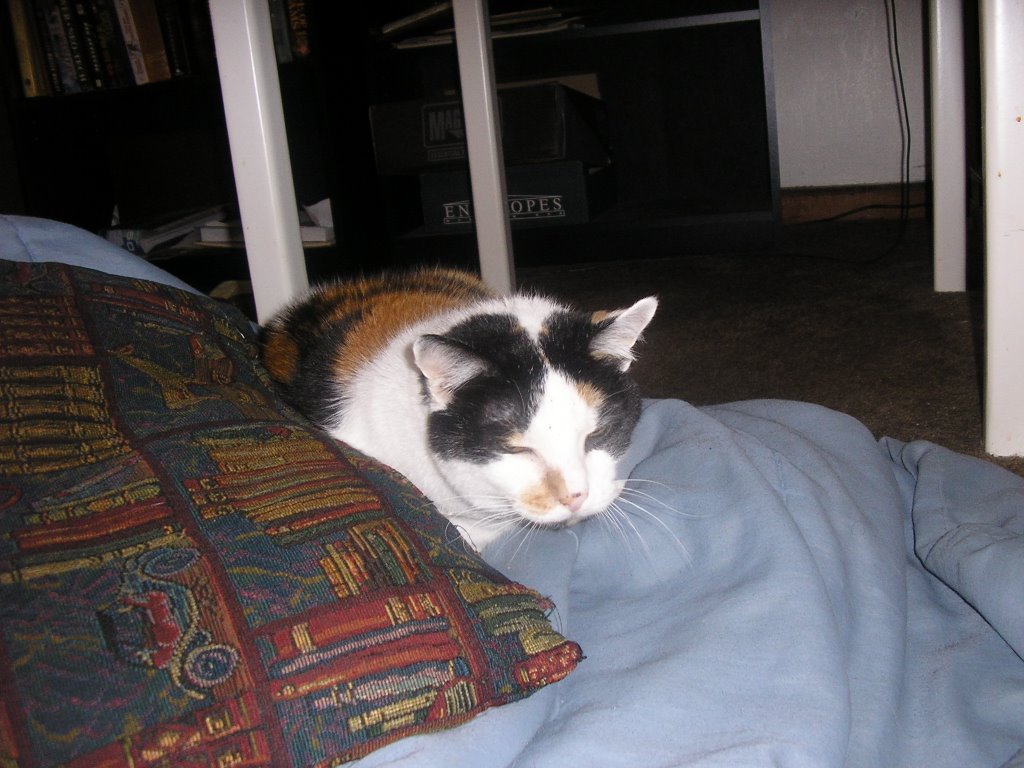
So don't worry, for now, Ms. Johnson is eating and drinking and using her litterbox just fine, and walking around the best she can. As I left it last, the vet thought she had idiopathic vestibular syndrome; I still think she had a stroke. She can get around the house just fine, though she's learned she can't depend on her hindquarters to get her up onto the furniture dependably any more. She has less energy than she used to and sleeps more, but she doesn't seem to be in pain. In short, she's old. According to some web site (http://www.catage.com/), she's 84. So I imagine she'll get by as she is until some other event takes place. So thanks to all of you for your sympathy, but be assured: Ms. Johnson is dying, but no more so than we all are.

So I believe I paused her life story at the point at which she and Thunder were flown to Nashville from Albuquerque in 1993. At that point, Ms. Johnson was about 3 1/2 years old, Thunder was about 2. This was in late August, and I had to pay extra to fly the cats because it was too hot to let them sit on the ground, especially since they had a changeover (in Texas, I bellieve). My plan was to have my mother, who was 71, pick them up at the airport in Nashville and take them to her house in Manchester, where I would join them all as soon as I wound up some things in Albuquerque. Before the airline would take them, the cats had to go to the vet to have their shots caught up and be certified healthy for the trip. I also asked the vet for some kitty downers to sedate the cats during the flight.

Have you ever tried to get a cat to take a pill? They don't even have the minimal cooperation that dogs do. In the course of trying to get Thunder to take a pill, she clawed the hell out of me, so I decided both cats would have to fly unmedicated. They arrived in Nashville kicking and having screamed themselves hoarse, to be picked up by someone they barely know and taken to a house to live with a spoiled poodle puppy for a week before I arrived. Needless to say, in the months they spent in the house in Manchester, they did not adapt well to their environment. Thunder in particular became so neurotic that she basically licked all the hair off her body. The cats didn't like Suzy the poodle, so my mother didn't like the cats. Chaos.

When I finally got moved to Nashville in the spring of 1995, I was in a very small apartment with no place for the cats, so they had to stay in Manchester. To defuse the inferno in the house, my aunt covered up an old beagle pen at my mother's house and adapted it for the cats to live in. Bear in mind these were inside cats, declayed and spayed, who had really never been outside. But outside they went, into two renovated doghouses, later adapted with light bulbs for heat in the winter. Their health improved dramatically in the poodle-free environment. Thunder got her hair back and they both seemed much happier, confronted with the wonders of nature for the first time.

And here's where my neglect of Ms. Johnson comes in. I mean, she was always fed well, but never wanted anyone but me to pet her (Thunder basically ran from everyone). So I never made it a priority to move the cats to Nashville; my apartments were too small, or shared, or too chaotic for me to bring them into it. My excuse to myself at the time was that they were happier and better off where they were. When I'd visit my mother's, I'd always go out to see them, but rarely went into the pen except to feed them (it was a very low-roofed pen), and when I did, neither cat really came out to be petted. So by the time my mother died in 2003, and I sold the property and the cats had to be moved, I figured they barely remembered me and no longer thought of me as their owner. By the time I finally got myself resettled into Nashville in February, 2004, and was ready to bring them to live with me, they had been forcibly evacuated from their pen (when the house was sold in November, '03) and taken to live in a well house at my dad's place, with no real protection (at my mother's they had the pen, and although the gate was usually left slightly open but locked, they had the protection of the small opening and then the doghouses).

Tragically, in the weeks when I was preparing the move, Thunder disappeared. She never could stop exploring; Ms. Johnson had gotten conservative and stayed under cover. Probably something took her and killed her. Thunder was always a little dense or couldn't see well, I never knew which, and she was declawed and defenseless. So my negligence really led directly to this death. My dad didn't know anything about cats and didn't care about them. Purely and simply, I neglected this obligation I had assumed. Between all the inevitable guilt feelings about my mother's death, and then the death of this cat, my position about assumed responsibilities has changed. Although people and animals will continue to die "on my shift," inevitably, they will never be neglected again.

So in late February, 2004, Ms. Johnson moved into the duplex in Nashville where she lives with me today. She gets just what she wants to eat and will get all the medical care she needs. Regretably, the one thing she can no longer do since her medical event of last month is get up into the recliner with me where she always came to be petted while I watch DVD's. If I help her, she just jumps down. She's just like that. Her favorite food in any brand of Fancy Feast with gravy, although she just licks the gravy out and leaves the meat. I don't mind, even though hard times are coming financially. She will get what she needs in her old age.

Friday, June 23, 2006

Shoes Outside the Door


Shoes Outside the Door : Desire, Devotion, and Excess at San Francisco Zen Center, by Michael Downing.

Yes, this book has hallmarks of sensationalism. And though I don't take a word of it as gospel, it's interesting and thought-provoking, especially if you've had extensive contact with any kind of large religious organization. It's the story of the San Francisco Zen Center from its creation in the sixties, through the early years of this millennium, with its focus on Richard Baker, the dharma heir of Sunryu Suzuki, the SFZC founder.

To very briefly summarize, Sunryu Suzuki was a Buddhist priest who came to the United States from Japan, sent by the Soto Zen hierarchy to run a Japanese Zen temple in San Francisco. But Suzuki had his own agenda; to reform corrupt Japanese Buddhism. He to some extent abandoned the congregation to which he had been assigned and began teaching American students. His early students included one Richard Baker, who was instrumental in creating what became the SFZC. Upon Suzuki's death, Baker was his only dharma heir in the United States, making him the leader of the Zen Center. Under Baker, the Center became a huge presence in the Bay Area and nationally; at its peak, it ran a number of businesses in San Franciso, including a bakery, a stitchery, and a greengrocer. It had a large resort/retreat center/monastic training center about 150 miles south called Tassajara, and a farm in Marin County called Green Gulch. The institution became such that a large number of Zen students who came to live at the main temple on Page Street in San Francisco were housed by the SFZC, and put to work in one of the businesses, at Tassajara or otherwise, paid nothing other than their small monthly stipends, and worked so much they seldom had time for zazen or any other Zen practice. This was all done under the rubric of "work practice." The culmination of work practice came with the opening of Green's, a high-end San Francisco vegetarian restaurant which is still existence today, known for the high quality of its cuisine and for its priciness.

Of course, Richard Baker wasn't living on a small monthly stipend. The real focus of this book is on the abuse of power by Baker-roshi. Baker seems to have taken the Zen Center bank accounts as his personal checkbook, living in opulence while the students just squeeked by. Of course, along with the lavish living came womanizing, and the title of the book refers to the occasion which brought the whole situation to a head (ouch!); at a "Buddhist Peace Conference" (whose attendees included Thich Nat Hanh) at Tassajara in 1983, Baker's affair with the wife of his rich friend, who happened to be a big financial backer and advisor of Zen Center, became so obvious that it brought a public outing and direct legal confrontation with the husband, at which point all of the stored angst of the other Zen Center higher-ups came out in what has come to be known to Zen Center as the Apocalypse. The torrents of the Apocalypse washed Baker out the door, and apparently turned Zen Center into an original American institution: a leftist Zen bureaucracy, rife with psychoanalysis, which today exists in its very un-Japanese form, with its affiliates, as probably the most extensive Buddhist organization in the US, albeit shorn of its industries.

Some readers of this book have oversimplified it and turned Richard Baker into the Jim Baker of Zen. Whether or not one believes Downing at crucial points, and regardless of the attacks made on the book by students of Baker and Zen Center students in general, I think he has done a good job of being objective, although this is belied to some extent by the fact that he can't keep from personally refuting a lot of Baker's excuses for his own behavior, probably because the numerous students interviewed never get around to doing it as systematically as Downing wants. Ultimately, Downing is an outsider, and the fact that he has never practiced Zen denies him a real understanding of what was going on. He has certainly done his research and garnered enough intellectual understanding of Zen to be objective; but his very limited experience with sitting deprives him of the real common ground he needs to really understand what he has read and heard. As good as his analysis is most of the time, whenever he discusses zazen he shows no understanding at all; he can only quote the Zen students, in ways that appear out of context. Most notably, his description of his own limited sitting experience shows that he didn't get it at all. It makes you uncomfortable the way Howard Cosells' boxing commentary used to.

Richard Baker was obviously not Jim Baker. He was and is obviously an intelligent, energetic and highly competent man, whose superior abilities made his impulses hard to rein in. As much of a scandal as the last years of his abbacy became to the Zen students and the Zen Center backers, it would take a lot more scandal to make the story lurid. There's no popular film here, no People's Temple, not even a PTO club. No one at Zen Center was abused, except financially and psychologically, and these people were not idiots, Most of them were and are highly-educated, spiritually motivated, and sincere. Baker was sincere, just out of control. His manipulative ability is evident. The subsequent reorganization of Zen Center with a system of checks and balances that would paralyze a government seems based on an understanding of what really must have gone wrong. It seems apparent that had Suzuki-roshi lived, or had he given transmission to another teacher or two so that Baker was not given ultimate power for a while, had Baker just had someone to keep him in touch with reality and the group conscience emerging around him, Zen Center could have expanded more slowly into what it may ultimately still become; a coordinating body for American Zen.

This book was meaningful to me because of the attenuated personal connections I have to Zen Center, and my recent very remote interaction with it. As recited in previous blogs, I first sat zazen at Zen Center in 1981. I didn't stick with it but my girlfriend Jane did, and she went on to become a Zen Center resident for a while at Green Gulch and worked at Tassajara Bakery, Zen Center's most successful business and the focus of Baker's attention until Green's took over. Later she moved out but continued to be affiated with Zen Center for several years. I went with her to Baker-roshi's Sunday morning talks at Green Gulch and spent a weekend as a guest at Page Street. I had other interests at the time, like law school and partying, so I was never more involved than that, but this book brings back all the people, places, businesses and practice I heard so much about at the time. I have strong visual images in my memory of Page Street and Green Gulch, but strangely of none of their people. During my last year of school, 1982-83, I lived in San Francisco at Oak and Fillmore, three or four blocks from the Zen Center, but I never visited, though many of the Bay Area scenes from the book resound in my mind. More recently, as you have read, I have made a connection with the Atlanta Soto Zen Center, which was and is simultaneously in the process of making a connection with the SFZC through its Austin Zen Center affiliate; in fact, Barbara Kohn, the current abbot of the Austin center and previous abbot at SFZC (they have limited terms, now, for some reason) was visiting at the Atlanta center the first time I visited, and I had the benefit of sitting with her. Presently, the Atlanta abbot is in residency at Austin to further a connection with them, among other reasons (some of which are opaque to me as an irregular visitor at Atlanta, since I am four hours away).

All of the above is brought into context by the book. I sit with a very loosely-knit group in Nashville, whose commitment for the most part to group activity is to sit together once a week when our schedules don't conflict. When I returned to Zen after over twenty-three years, I was seeking some more. This seeking led me to Atlanta, where I've found a lot of what I was looking for in terms of authenticity and commitment. I was initially overjoyed to find out about the evolving SFZC connection. This book gives me some perceptive.

I think what I was hoping to find was the security of an established lineage. My perspective on all that has changed. For one thing, all of the Japanese founders of Zen in America seem to have been rebels, to some extent. Sunryu Suzuki is a good example. I appreciate him more after reading Shoes Outside the Door, and I need to read more of his work. I have never really liked his best known work, Zen Mind, Beginner's Mind, which is actually a rendition of some lectures he gave in Los Altos by one of his disciples. Apparently Suzuki-roshi had hesitated to have his words in print; my understanding of why is that all of his statements were made in context and were not to be taken as universal truths. I love that; it helps me understand why outside of Dogen, virtually everything I've ever read about zazen is crap. I sit at weekly meetings of the Nashville Zen Center seething at almost every reading, done as if they were daily devotions. I truly believe that everything said about Zen which is not directed toward immediate practice is wrong, by definition.

Anyway, although Suzuki-roshi was sent to San Francisco by the Soto heirarchy, he truly believed Japanese Zen had become decadent, a theme echoed by virtually all of these transplant teachers. His own son had to be given transmission to assume the father's "hereditary" temple in Japan, yet the son never or rarely sat zazen. It really seems Sunryu Suzuki was as much of a rebel as is Gudo Nishijima, Brad Warner's teacher. And yet at Atlanta Barbara Kohn characterized Michael Elliston's teacher Soyu Matsuoka as a rebel.

It is beginning to appear to me, from this book as well as from various firsthand accounts, that Zen in Japan is a corpse, a body with little or not soul. Please convince me that I am wrong. From all I can find, Zen interest in Japan is all among old people, and Zen priests have little function other than officiating at funerals; zazen seems rare. Has the practice been revivified in America, or is what we do something new altogether? Have we saved Buddhism or transformed it? I don't know the answers to these questions. If you do, please tell me. I have no doubt of the validity of the practice or of the validity and sincerity of (most of) the teachers I know. But as American Buddhists, what exactly are we?

Of course that's rhetorical and ultimately unanswerable, I guess. A few other points bear mentioning. The instant book emphasizes, intentionally or not, how psychological counselling and its lingo have become integrated into SFZC's version of Zen practice. In retrospect, I can see some (to me, welcome) aversion to this trend at Atlanta. It seems to me that psychobabble is antithetical to Zen, but what do I know? It still appears to me that Christianity is incompatible with Zen, but some much more experienced practictioners and teachers seem to disagree with me.

So I know the bottom line is, sitting is sitting, but the mind has to be occupied with something, and I could do worse that all this. The book was a pleasure to me, partly because of memories evoked. Whether or not the story here is "true", or more likely just one of many possible stories, is not the issue, so much as that this story does not seem to be false. I don't like koans because as a philosophy major and then a lawyer I think I burned out on word games a long time before I came to this book. I'd love to read or hear a chronicle of these same events told from the inside out, by one of the students, hopefully one without a big axe to grind. Until then, this is the only history of the period I've seen. Let me know if you have another perspective.

Wednesday, June 14, 2006

Ms. Johnson, part 1

No, Ms. Johnson is not dead, as you may have wondered from the title of this. In fact, she seems to be recovering from what the vet said this afternoon, was probably idiopathic vestibular syndrome, which basically means dizziness for an unknown reason. Last night, I heard a crash in the kitchen; she was either trying to get into or out of her litterbox, and crashed face first into the floor. I picked her up and she couldn't walk. She took two steps, leaned her head to the right, and her whole body followed her head over. I'd noticed that she'd been hiding out in her nest in the bedroom for a day or two and heard a couple of inexplicable crashing sounds, so it may have come on anytime in the last few days.

Since she couldn't stand up or walk, and she seemed out of it, I called and took her to the afterhours emergency clinic. She had a full blood work-up which showed that all of her levels were unremarkable. That vet, who was not "her" vet, said she seemed healthy for a 16-year-old cat. Her hearbeat and breathing were good, and she seemed fully hydrated. She thought that said vestibular syndrome was the best best, or it could be a cancer or a brain tumor. Ms. Johnson got a mild steroid shot, and came home.

Although she couldn't walk, she was able to get where she wanted to go by either walking a few steps, falling down, then getting up and walking again, or crawling/slithering. I gave her her favorite food, which is any kind of Fancy Feast with gravy (although she usually eats the gravy and leaves the meat chunks unless she gets really desperate. If anyone knows where I can get gravy alone, just let me know. I tried her on canned brown gravy and she just sniffed it good.). She perked, up, walked over to the food, and fell into the plate head first. After I picked it up from under her, she did stand up and eat all the gravy before walking away and lying down again. I tried to get her to drink some water, but she wasn't too interested. I guess water has the same gag reflex humans do for water when they're ill (and what is the evolutionary sense of that?).

Anyway, I took her into the "normal" vet today for a follow-up, and she seems to be recovering a little. If it is the vestibular syndrome, she should recover on her own at her own personal rate, anywhere from a few days to a week or two. If it's a brain tumor or something, there's nothing to be done, I guess. She could go in for x-rays or an MRI, but I don't see the point if there's no treatment. I'm just going to watch her til Friday and take her in for another fluids injection (she got one today; she seemed a little dehydrated this time) if she's not drinking well by then.

I'm not sure what the point of my reciting all this is, except that it does to connect to a lot of topics that are occupying or pre-occupying me these days. Life, death, attachment, old age, sickness, love, attachment, and attachment. Sickness and death in particular seemed to be surrounding me very recently, though the tide has ebbed for the most part. The major death that will ever occur in my life occurred three years ago, and although in one sense everything else that occurs will be anticlimax, I expect the presence of death to be more and more immanent (bad grammar; you fix it). Lately I've been telling my self that I don't want any more attachments, to anyone or anything. I'm hoping that all the people whom I love die before I do, because I'd rather feel the pain myself than see them go through it. Most of the people whose death will affect me severely are a lot older than I, with one exception, so most likely I'll get my wish. Certainly, with Ms. Johnson, the 16-year-old calico, that will almost certainly be the case. Although I know it will be most painful to me when she dies, I'd rather that than for me to die and her to be alone, for she is the most uniquely bonded cat I have ever seen, and she will never be anyone else's pet. I undertook an obligation over sixteen years ago to house and support her. I failed in that obligation for a while, just as I've failed other; and I sincerely hope that she will live a while longer, but that she dies as painlessly as possible before I can ever let her down again.

In 1990, I was an attorney beginning my seventh year of practice in Albuquerque, New Mexico, almost four years into solo practice. I was renting my office from my benefactor, landlord, friend, and all-around strange guy Jim Ellis. About February, Jim walks in with a couple of fresh Route 66 street orphans, Ms. Johnson and her brother, barely-weaned kittens off Central Ave. (yeah, that's Route 66). Ms. Johnson was unconscionalby charming. I took her home without premeditation. The brother was taken home by Terri the secretary, but subsequently disposed off somehow due to his outlandish temperament. True to my temperament, I made the equally asocial Ms. Johnson a permanent part of my life.

They say children are created by the neuroses of their parents (or I say that, anyway). I didn't know how to handle relationships at the time, and I certainly created Ms. Johnson. I didn't and still don't like to have other people in my house very often. Ms. Johson grew up thinking nothing ever moved but her and me.

When Ms. Johnson was a little older, Paulette used to bring other kitties over to play. Ms. Johnson used to try to kill them all. When my dad came to visit, and tried to take the vacuum cleaner back up the stairs, Ms. Johnson backed him down. She weighed about five pounds and she was declawed, but you would have backed down too. She was and is incredibly fast and incredibly smart. Her other trick was to come down the stairs and attack people sitting in the one chair, from behind and above. I think she may have scratched an eyeball or two. I just laughed.

In early 1990, I was probably in the third year of an unmedicated manic phase that crash-landed when Ms. Johnson was about eight months old. I'm probably exaggerating; maybe not. I have never been diagnosed, just misdiagnosed, and if either ever happens again, it is not with my cooperation. Nevertheless, Ms. Johnson loved me, and nobody else. Never related to anyone else. Never has and never will.

In the spring of 1991, out of the mania phase and into another destructive phase entirely, I tried to mellow Ms. Johnson out and got her a friend. Thunder was a cute littel pastel calico from a healthy home. She was the runt of the litter and I named her to make her a little bolder. It didn't work. I was never quite sure if she was a little blind or a little stupid or both, but I loved her in an entirely different way. The roles couldn't have been any clearer. Ms. Johnson tried to get rid of Thunder too, but I protected her and let Ms. Johnson know -- and she did know -- that any harm to Thunder was unconscionable. I think Ms. Johnson was me, and Thunder was the other side of some abusive realtionship that never lasted that long in my life, or maybe it did. I don't want to know. I don't want to find out. No more relationships. No more danger to anyone.

Things blew up for me in Albuquerque in the middle of 1993. Gotta go. Gotta run. I ran back home to my mom's house in Manchester, TN, and the cats came with me, against her will, and were the mistreated stepchildren til my mother died in 2003. In 1993, I told my mother I was bringing Thunder and Ms. Johnson back to her house to live until I found a better place for them. Unknown to me, right before I arrived, she went to a pet shop or something and bought a poodle named Suzette, who never got called anything but Suzy. She never told me; she never told me. My mother called Paulette to ask her to ask me not to bring the cats.

All this became known to me a few weeks before I left Albuquerque to come to Tennessee. It was too late for me to do anything else. I could abandon a lot of things, but not the only two creatures that had been consistently loving to me for these years. I paid $100 apiece to fly the cats to Nashville in late August, 1993, and arrived the next week.

I have to finish this later. It's 2 a.m. and she's still not drinking her water. She doesn't seem to be in pain. She thinks she's just sick and will get better. Don't ask me how I know if you don't haven't had a pet for a long time. Right now, I don't know if she'll get better or not. Right now, I know she's been more consistently loving to me than any human being left alive. Despite the fact that I didn't treat her right for most of her life. This is not the way it should be. This is the way it is.

Friday, May 26, 2006

New York Doll


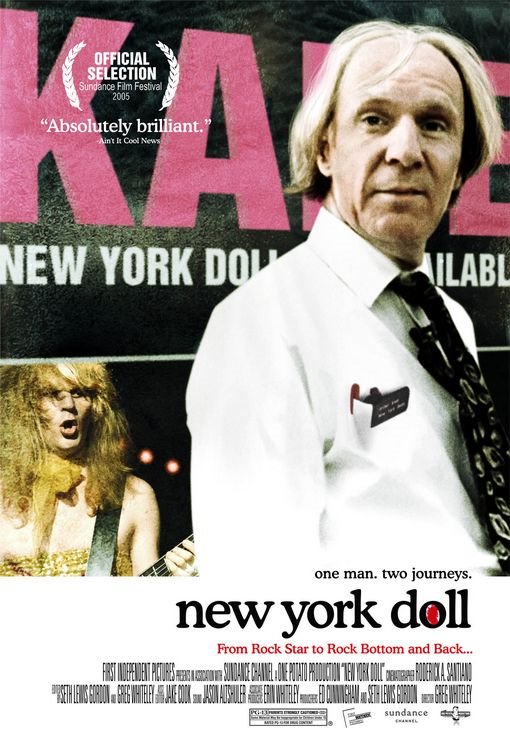
For some reason Brad Warner just dumped all the postings off his blog and his web site, but just before he did, he turned his readers on to New York Doll, a partial biography / rock and roll documentary about Arthur "Killer" Kane, the bass player for the New York Dolls, the best rock and roll band ever. I had put the movie on my Netflix list, but I couldn't wait and watched it on my On Demand tonight. If you remember when rock and roll was music, when its stars were artists, you must watch this movie. But more than that, this brilliant film is the story of life.

I turned fifteen in 1972, and that was the year I discovered music, or rock and roll, which is a different discovery altogether. I think I'd started reading Rolling Stone, and from there I went from whatever I was listening to on AM radio in Manchester, TN, to the artist-oriented music that defined the changes that were occurring in my life at that point. I think the first two Serious Rock albums I bought were John Lennon's Imagine and Bob Dylan's New Morning. From there I went on into reading Circus magazine and a bunch of crap, but it led me to new bands that were rising from the ashes of rock -- bands like David Bowie, Queen, and the band that changed everything, the New York Dolls.

I remember feeling I was a little too young, a bit too late for everything in the early '70's. Woodstock had occurred when I was 11. Jim Morrison, Jimi Hendrix and Janis Joplin died that year or the next and the Beatles broke up. The War in Vietnam was winding down, and about the time I started high school, the draft was abolished. Rock had gone to Hell (to be rescued for while, and then go there permanently to live). Those were the days of wimp rock on the radio; the alternatives were Led Zeppelin, Emerson Lake and Palmer... it was a bad time. It was gonna be a while before 1977, when Elvis Costello, the Sex Pistols and the Clash gave rock its best year ever and its final one.

So when my classmates were all listening to the Allman Brothers, the Marshall Tucker Band, Charlie Daniels, Alice Cooper, Jethro Tull... I got lucky. The first and best rock concert I ever attended was David Bowie and the Spiders from Mars on the Ziggy Stardust tour, at the War Memorial Auditorium in 1972 or early 1973. I think my mother drove me up to Nashville from Manchester, 65 miles away. If memory serves, I took a friend with me, Michael Bell, who turned out to be my first pot connection.

Anyway, riding on the coattails of Bowie and Marc Bolan's T. Rex were a lot of glam rock wannabees. One of those bands, indistinguishable from the others in Circus, was the New York Dolls. My initial impression of the band was just that they were Out There. They all dressed in drag. Whereas Bowie looked like a space age androgyne (a concept I wouldn't understand til years later), the Dolls just looked like transvestites. I was shocked and intrigued. One of the best blind guesses I've ever made was going out and buying the Dolls single "Who Are the Mystery Girls?" on a 45 single. I was hooked, and I wore out the grooves.

I think at that point I already had the Stones' Exile on Main Street, their best album ever. My initial impression of the Dolls was that they were the Stones, but rawer, wilder, and better. Somehow in that high school time I picked up the Dolls' two albums, and I loved them more and more with each listen. This was about the time I picked up Lou Reed's Transformer and everything changed.

Well, I thought everyone was getting hip to these new bands, but they weren't. I started college in 1975, and just after that, punk hit. Of course, I'd been listening to punk for years, but it didn't have a name yet. In New York Doll, Mick Jones of the Clash acknowledges his debt to the Dolls. In 1977, Johnny Rotten said rock was dead, that the Pistols were the end of it, and he was right. Everything after was derivative. These days I listen to jazz and classical, waiting for listenable pop music to reappear, but the odds of it happening in my lifetime...

Anyway, New York Doll is a great movie because it's about the New York Dolls, but it's a greater movie because it's about me, about my life in the way every great work of art is. The Dolls only released two albums, I think in '72 and '73, though I understand from the movie that they staggered on until about '76 before they finally disbanded. In 1979, I dragged my fiancee, with whose family I was visiting in New Jersey at the time, into The City for two nights. I'd been lusting after the music listings in whatever NYC free press I'd picked up at the time. No one else I knew was into the bands I was, but I didn't care. Out of that whole stay, I think I only managed to get to two nights of music. I saw the Plasmatic at CBGB, and I saw Johnny Thunders and the Heartbreakers (with Cheetah Chrome of the Dead Boys, separately) at Max's Kansas City. Those Heartbreakers concerts were later released as a classic album. I remember Johnny Thunders, drunk and full of heroin, 2 1/2 hours late, smashing his drink glass by throwing it straight up at the eight-foot ceiling, and Ty Styxx coming over the drum kit at him. My life was never the same after.

Johnny Thunders and Jerry Nolan died of heroin long after leaving the band. David Johnanssen went on to become Buster Poindexter. Arthur Kane wound up broke in LA, dreaming about his glory days.

Apparently, he was a drunk and went through AA, but the turning point, or new point of stability, in his life, seemed to come when he entered the Mormon Church. Apparently, he sent off for a free copy of the book of Mormon, which came delivered with a couple of hot blondes. Soon after, his prayer resulted in a conversion. My impression from the movie is that at least 20 years of his life consisted of riding the bus from his home to his job at the Mormon Tabernacle in LA, where he maintained records. He always dreamed of a Dolls reunion. Then, in 2004, Morrissey made it happen at a British festival. The movie depicts the reunion of Kane, Syl Sylvain, and Johannsen (who had become an adversary in Kane's mind by way of his relative success) and their successful performance. I won't tell you the ending, because it almost made me cry, no shit. Rent it.

But as I said, the movie was great art because it called my own life into play. When the Dolls were at their peak, I was in high school. I graduated in 1975, and then graduated first in my class in liberal arts at the University of Tennesse in 1979. In 1983, I graduated with a JD from Stanford Law School. I was pretty impressed with myself, but I thought I was better than my environment.

All that came to an end for me in 1993. These days I can't even find a decent job. But I remember who I am, and what I've done. And thanks to Arthur Kane, I know tonight that I'm still me -- that I'm as good as I ever was.

There are other points to be gotten from this film. How with the Mormon Church, Arthur Kane found his sangha, something I haven't been able to do in Nashville. But I'll leave those for now, because the story of Arthur's life has taught me for the moment that I'm OK, and that my life is worthwhile, and that I don't need to be valued, validated or limited by the others by whom I'm surrounded. And that's what great art does.

Friday, May 19, 2006

Legislative Intolerance: Mexican is the New Gay


As Hunter Thompson said, the American Century is over. All we have left is fear and loathing.

I've tried so hard to avoid politics lately, or what used to be politics -- politics ended when the Bush Cabal stole two elections in a row. I can't even watch the news anymore on TV, and I'm thinking of having the cable disconnected. I can get what passes for news these days on the internet, story by story on a far cooler medium where I don't have the assininity of modern America thrown in my face by brainless hacks.

I haven't said a word on this blog about the continuing slow death of our Constitution, about how the "government" grows its slimy tentacles of inquisition inside our bodies and our lives like a cancer of the soul (yeah, the soul is a social concept but give me some license here). About the wiretaps and the phone records. I've been applying for jobs lately, which doesn't really make me festive anyway, but the information they can demand and get these days would have started a revolution among our forefathers in previous, saner generationss -- and by "they" I mean in this instance the employers and the mercenary inquisitors who search like mortgage lenders through the sins of your youth for bloody gold; but overall I mean all of us in our ignorance who have allowed this monster to grow within the public body. But I haven't written about all that, because it's right in your face now, and if you can't see it for yourselves, I hope your God helps you because there's nothing else I can do.

But that's not what I'm writing about today. The obvious evil that's been huddling on the horizon has descended to the valley. I'm wondering what took them so long; it's been so obvious. Last night at 2 a.m. I got up and checked the internet, and was confronted with the following story on CNN:

Senate says English is national, unifying tongue

By Donna Smith Thu May 18, 9:33 PM ET

WASHINGTON (Reuters) - The Senate agreed on Thursday to make English the national language of the United States and moments later also adopted a milder alternative calling English the country's "unifying language."

Which amendment ends up in the final version of an overhaul of U.S. immigration law will depend on negotiations with the U.S. House of Representatives. Neither would bar the use of Spanish or other languages in government services.

The Senate immigration plan couples tightened border security and enforcement and a guest-worker program with measures giving a path to citizenship to some of the 12 million illegal immigrants, most from Spanish-speaking nations.

"This is not just about preserving our culture and heritage, but also about bettering the odds for our nation's newest potential citizens," said Oklahoma Republican James Inhofe, who sponsored the national language amendment, which passed by a vote of 63-34.

The United States currently has no official language and some lawmakers said they feared Inhofe's amendment would lead to discrimination against people who are not proficient in English. They also said it could hurt efforts to promote public health and safety in other languages.

"Although the intent may not be there, I really believe this amendment is racist. I believe it is directed at people who speak Spanish," Senate Democratic leader Harry Reid of Nevada said.

The issue is politically popular, and in a congressional election year lawmakers strongly supported both measures. Inhofe said opinion polls showed 84 percent of Americans supported making English the national language.

The Senate, by 58-39, also agreed to an alternative offered by Sen. Ken Salazar, a Colorado Democrat, stating "English is the common and unifying language of the United States that helps provide unity for the people of the United States."

When I got up for real this morning, the headline was gone and I had to look up the story, like it had been deemed either unimportant or unreportable by the Bush Cabal censors. I copied the relevant portions here because links have been known to disappear.

So it's official now: Hispanic is the new Gay. The gay-bashers of two years ago are the xenophobes of today (someone give me a more specific word for the phobia for unreasonable fear of Mexican immigrants, please).

Can't you see that it's all about fear? Fear and loathing, but loathing comes from fear. In Buddhism we say, and I paraphrase, that the three great obstacles to "enlightenment" (i.e. properly living in our world) are greed, hatred and ignorance, but it all comes down to ignorance in the end, now doesn't it? And fear comes from ignorance too, for most of us. There is a primal, real animal fear that comes when you're about to be munched by a beast with claws, but with us it's usually not that, it's a conditioned response brought about by our ignorance. So we haven't learned that the ones we should fear are the ones who are manipulating our own fear responses, and we let them because of our ignorance. And yes, it's their own ignorance that makes them do it, to think they have something to gain. As much as I can talk about evil, I really don't believe in it. The smirking face of evil in our time is the awful grimance of George W. Bush, the public face of a moral and social cancer that's eaten our nation, our civilization, and everything our forefathers died for; but it's just a mask for ignorance. He, too, and his puppetmasters will die alone with only their own existence staring them in their double faces.

As I've said before, there is nothing in our Constitution to stop the hatemongers and fearful Anglomaniacs from making English the national language. So did you ever what has stopped previous generations from doing this? Was it because it was unnecessary? Or was it because they were still enough in touch with their consciences to know that it was just wrong?

I know this was tried on a State level in Colorado in the late '80's or very early '90's and it was shut down. I can't remember why. State Constitution? Oh, and by the way, those of you who want to comment on these blog entries but are either too inept or lazy to register with blogspot, or who just don't want their comments posted publicly, can now email me; the link is in the full profile. So let me know if you remember the legalities here.

I guess the fearful and loathsome think this country was settled by English-speaking immigrants alone. I recommend an elementary-school history course. I understand that history is no longer taught in the schools, so you'll have to find someone over thirty to help you. If you're over thirty and don't know any better, shame on you. I'm about 6.25% Cherokee, so I recommend making Cherokee the national language. They were here first. It was their country. But oh yeah, we killed most of them off, didn't we, and most of them who can still speak at all speak English only, probably.

So Hunter, be glad you took your ticket out when you did, and didn't have to see it getting worse and worse. I'm glad my mother didn't have to see it. So now I'm going to meditate and hope I can get some equanimity back. And then I'm going to watch some anime. Anime makes me happy. Modern America makes me sick.

Thursday, May 11, 2006

The Power of Magical Thinking


No, that's not a Zen altar; it's a Nichiren altar, and I'll come back to it in a minute.

Every time I go to Atlanta for a sesshin, I come back with something from the discussions that stays with me. Last month it had to do with vegetarianism, and I'll get around to writing that one eventually (the insight was not about what we eat, but about how we live). Last weekend, it came in the form of a question or response during the hosshin or mondo session; it was pointed out by the abbot that Zen expressly disclaims that we can influence the "outside" world by our zazen. Obviously on some level the distinction between the outside world and ourselves breaks down, according to one's understanding, but all verbal statements must be taken in context. The point is, from within the duality, our goal in meditation is not to improve the circumstances of our lives, but to improve our ability to cope with them (insofar as the goal of zazen has any external referent at all, but bear with me).

In other words, if my car breaks down, no amount of zazen will get me a new car or get my old one fixed. And although the goal of zazen is not to improve my ability to cope with the situation, that is often the effect. Back in my days with the Nichiren Shoshu of what is now the Soka Gakkai in the 1980's, the opposite attitude was encouraged. If you don't remember, the Nichiren people chant Nam-myo-renge-kyo (which is pretty much, devotion to the title of the Lotus Sutra), believing that they can reach enlightenment thereby. But not just enlightenment; newcomers are encouraged to chant for whatever it is they want, be it a new wife, a new job, etc. Believers are taught that by changing the karma from this life and past lives, by chanting the mantra, they can actually change the instant material conditions of their present.

I don't think I ever believed this, but I stayed with the practice for a couple of years because I did in fact receive benefits from the practice in terms of the effect it had on my lifestyle and on my insight. Part of this I'm still pretty sure came from the practice; even at my most cynical about the Nichirens, I would still say that any form of meditation practice is better than none. Part of it I'm also sure came from the fact that I was leading meetings and had to explain this stuff again and again, and I found a way to rationalize it all. In a way, the belief that one can dissolve the effects of one's karma instantaneously is akin to the concept of beginner's mind: I can start from scratch right here, right now, in this one timeless moment. It can be a useful concept (bad word) to get rid of mental baggage and be in the moment.

I won't go into all the rationalizations here, but some of them led to more useful (for me) concepts during the couple of good years I had after I quit the Nichirens, when a lot of the concepts which I thought were mine alone but I found again when I returned to Zen in 2004, were formed. What's pertinent was the thought that one could change one's world by religious practice, which is pretty much what's referred to in modern psychology and anthropology as "magical thinking." The best definition I could find without extensive effort on the internet (and I don't have a source to cite for it, so, sorry...) is:

1. The conviction of the individual that his or her thoughts, words, and actions, may in some manner cause or prevent outcomes in a way that defies the normal laws of cause and effect.
2. A conviction that thinking equates with doing. Occurs in dreams in children, in primitive peoples, and in patients under a variety of conditions. Characterized by lack of realistic relationship between cause and effect.


As if anyone actually knew what all the laws of cause and effect are! But it gets the point across. Most religions and a lot of other belief systems have this kind of thinking as part of their premise -- think Voodoo. It's also a very normal part of the individual development of a child's thinking. Avoidance of magical thinking is ultimately why I had to come back to Zen as part of my need to return to ritual (which I contend is necessary for mental health) without having to believe that gods are being invoked, etc.; it's ultimately why my brief flirtation with Tibetan Buddhism didn't last long. It's associated with the openness of Zen to open-minded modern science, which is pretty much unique, the attempt of the Dalai Lama to wrangle neuroscience into Buddhism notwithstanding.

Anyway, back to Nichiren Shoshu. After chanting for a while, it was my perception that while external circumstances did sometimes oddly seem to change when a person started chanting (and yes, there are lots of real-world explanations for that one), more often the person started to conform to the world. In other words, my observation that was that after a period of practice, the goals one was chanting for seemed themselves to change. If a person started out chanting for a new car, whether or not he got the car, if he was still chanting a year later, mostly likely he was now chanting for understanding, or some other attainable goal which did not require magical thinking.

I still maintain that the chanting of Nam-myoho-renge-kyo was a beneficial practice for me; it changed my life in a very positive way, and it was the bullshit associated with the rest of the practiced and the organization of the Soka Gakkai that drove me out. But after a couple of years, and explaining the practice to myself and to others (in a very unorthodox way, I may add), the context in which I was doing the chanting was a lot different than where I started, and very different from where the beginners were told to start. And in fact, the organization itself, once you got to a certain level in the heirarchy or in experience, would admit that all the promises about material benefits made to beginners were just the lure; that the practice itself was bound to change the person and deepen his understanding. And from my experience, those whose understanding didn't grow weren't around long.

I'm a big fan of science fiction and fantasy, and I love well-written stuff about magic. I just don't believe in it in real life. Or I try not to, but it's a real danger I have to avoid every day. But consider: in a deeper sense, you and the universe are the same, so does not the change in yourself change the universe? Undeniably, it does. No matter how deep our understanding becomes, when we return to the realm of discourse and rational thought, we cannot explain nor conceptualize the real working of cause and effect. Now, I think that there is a definite line of definition between magical thinking, or just plain wishful thinking, and where we can realistically expect the benefits of our practice, be it Zen or anything else, to take us. But sitting here at this keyboard, just how to define that line eludes me, as perhaps it should.

Monday, May 08, 2006

Capote


Nice pic, huh? Richard Avedon, believe it or not. Avedon apparently also took pictures for Capote's book In Cold Blood, according to the movie I saw last night which was, obviously, Capote. This is Truman, by the way, not Philip Seymour Hoffman, who won the Oscar for his portrayal. Hopefully Philip does less drugs than Truman did.

This is not normally a movie I would blog on, but I happened to watch the movie just after returning from a weekend sesshin in Atlanta, so perhaps I learned something I wouldn't have otherwise. It's not that the movie isn't well done; it is. Not only Hoffman's performance, but all the performances, are excellent. As movie-making, it's an excellent example of how craft can make anything shine, since really I'm not sure there's a movie here; or if there is, it's a very small one.

If you haven't seen the thing (and you should, as I said, just for the performances), it's basically the story of how author Truman Capote, a famous and infamous novelist, went to Kansas in about 1960 seemingly on a whime to write a town's reaction to the mass murder of a family by a couple of drifters. His magazine article turns into a book (In Cold Blood) that occupies him over several years. In the course of his story, he strikes up a "friendship" with one of the killers, who he betrays and abandons to execution. Capote comes across as a manipulative shithead, which he undoubtedly was.

Hoffman deserves his oscar just for the risk he takes here. In the hands of an inferior director, this movie would have been laughable. Capote was a flaming gay in the 50's and 60's. I remember him from the talk show circuit in the 60's, when I was too young to know just what the hell was wrong with this guy. So the overall quality here made Hoffman's career, but it could have destroyed it. So I'm not complaining.

And this is still not my point, but as a side note, the critical acclaim and resultant popular success of this movie surely should tell us of at least one problem with the Oscar process. Because the main flaw of this movie is, except for the brief closing note (something to the effect of, "Truman Capote never finished another book. He died in 1984 of complications from alcoholism"), you'd never know that the whole point was that what Capote did to complete his novel and make it a success, mainly sell out and betray the convicted killer whom he had pretended to befriend, for the purposes of gathering information, and then abandon the man to die so Capote could finish his book and get it out in time to profit from the whole mess, killed Capote. Yes, that sentence is a mess.

But no more so than the movie standing alone. If you miss that closing note, and if you don't know Capote's life, all you'll see is very well made movie about a shithead. And I have to believe that when the movie was sent out to critics to solicit Academy Award nominations, they got an explanation, which is more than you get if you just buy the DVD. My complaint about the movie is that its whole point relies on a external reference for understanding -- the later life and death of Capote, which is not included here. So the bottom line is, the film is very well made but really, fatally flawed by no less than its failure to include its own thesis.

So why am I bothering to write this, and why did I give the movie four stars on Netflix? First, because of the quality of the craft in this empty vessel, but second because I learned something from the eliptical moral. If you've been following, you'll know that I've had some regrets about my past. I think we all do. In my case, I can't help but think sometimes how materially successfull I would be now / would have been if I had followed through on my legal career, had done this, hadn't done that, etc. But I've alive, and I'm not trying to forget about a bunch of people I hurt. I mean, sure I've hurt people, but not manipulatively or intentionally, and if it got me what it got Capote, then no, it wouldn't have been worth whatever benefits I received. So in the reflective mood I was in when I saw Capote, it was vindicating for me.

By the way, I did some research on Capote's end after I saw the movie, and even that little ender left out a bunch. He died, not just of complications from alcoholism, but of drug abuse, and specifically of an overdose at the home of Johnny Carson's ex-wife. His epitaph was a quote from Teresa of Avila: "There are more tears shed over answered prayers than over unanswered prayers."

The moral seems to be, as Spike Lee said, "Do the Right Thing." And maybe be more verbal when you'r trying to blog than I am right now. As Deuce Rufus said in his "Nekkid Sleddin" blog, "We needs practice."

Friday, May 05, 2006

Nothing of Consequence - An Update of Sorts


This is Mona the Beagle puppy. Sometimes it all seems to come down to this - a dog eating a piece of bologna.

No, I haven't given up blogging, I just haven't been inspired to say anything lately. For the last month or so, I just haven't been riled up enough or inspired by anything to write a decent post, so I haven't. My few attempts at writing for the sake of writing haven't been noteworthy, so I wanted to wait til I could give you something worthwhile. That time is not at hand, but to those of you who read this regularly, just wanted to prove I was still around, and to explain.

Back at the first of the year, I left one job (remember the stories of the homophobic/reactionary office manager?) en route to another, and the other vanished midway, so I've been taking the time to work on a few personal issues while waiting for something worthwhile. Since I've finally come to realize that a career is just not ever going to be the focal point for me, I've settled on finding some tolerable way to produce an income without doing something I object to or hate. As of this point, I still haven't found that, and I need to do something in the next six weeks or so. So there's one source of stress I can't blame on anyone but myself, and it doesn't make for interesting blogging, at least not at this point.

After the Atlanta trip (which I'm about to repeat this afternoon - it's a monthly option), I did come back and do a presentation on Zen at the Middle Tennessee Anime Convention, which should've produced something worth commenting on, but it hasn't gelled yet. Other than that, and the job thing, I've been working out and meditating, and then reading and watching DVD's and wasting time.

Meanwhile, everything else is about the same. The Bush administration is as stupid and evil as ever, and the American people are only catching on to a very limited extent. Particulary galling to me is the attitude I see everywhere, especially among leading Democrats, that, "We shouldn't be in Iraq in the first place (duh!), but now that we're there we have to stay." What kind of idiocy is that? This seems to fall into the category of throwing good money after bad, but what's worse is that it's not just money, it's human lives, and I can't see wasting even one over this stupidity. People are just going to have to open their eyes and see that all of these soldiers were conned into giving up their lives for nothing. In my mind, the Bush Cabal is personally responsible for every death and should be accountable therefore.

I almost wrote an entry on the whole Immigration flap, and I would've if I'd felt like writing at all. First, the Day Without Immigrants, what kind of a stupid idea was that? There were only possible outcome to the thing: (1) everything would turn out OK, which is pretty much what happened, so we could realize that the headache caused by illegal immigrants is much more than the benefit we receive from having someone to do those low-level jobs; or (2) a big mess could've happened, which would've just pissed off the legitimate population. Because see, some of you probably think I'm in sympathy with every liberal cause that arises, and sometime it sure seems that way to me, as a reaction to the Bush Cabal and the Christian Reich, but honestly, I'm not that big on pardoning illegal immigration. I would comment that the present immigration mess is redolent of the mess caused by American drug policy; the law refuses to accept reality, and thereby artificially creates a class of criminals. I may elaborate at some future date.

I could've shocked and offended my readers by coming out with a post pointing out that the only thing we need less than illegal immigrants is illegal immigrants who refuse to work. This might come as some comfort to any right-wingers who happen to read this, if there are any (they would have to be masochistic). But then, in his inevitable stupid countermove, Bush comes out against anyone singing the Star Spangled Banner in Spanish, showing that he just won't be out-dumbed.

I put people who insist that everything in the United States occur in the English language, on the same level as those who insist that everyone here be Christian; they are just naive and unaware of history. I wish I spoke a second language, but I don't; like a lot of us, I took Spanish in high school and French in college and can barely fight my way through a menu in either. But I have frequently observed that people who are bilingual, and especially those bi- or multilingual from childhood, have a big advantage over the rest of us, just not in practical terms (which is obvious everywhere except red-state America), but also in flexibility of mind. Even from my limited studies of languages, I know that learning to think in a different language forces you to reconceptualize everything, and so you learn a little more about perspective and reality. So yes, it would be to these Spanish-speaking immigrants a benefit to learn English, but no more than it would benefit us English-speakers to learn Spanish, and they have exactly the same obligation to do so: None.

As I learned when I lived in New Mexico for ten years, there are native Spanish-speaking Americans who were living and building a culture in what is now the United States whose ancestors were here when yours were still wallowing about in some European beer hall. There is room for more reminisce and extrapolatin here, which will have to wait. But if you think that English is the national language of the United States, get over it. Some of our little Nazi buddies in the White House (and in regular houses and bastions of ignorance around the country - there was even a state law proposed in Colorado I remember, and doubtless elsewhere) would like to make it that way, but they haven't, and I hope they don't. Interestingly, I don't know any reason they couldn't pass a law like that, Constitutionally. So enlightened America, watch out.

That's it for now. Hopefully I'll feel like extrapolating on some of this soon. Hang in there.

Thursday, April 06, 2006

Ruminations: Homecoming?


Sometimes these blog entries come really easy like the last one. Sometimes they roll off the tongue (or the fingers, I guess) like butter. Sometimes.... well, I should avoid intestinal metaphors. Especially after last weekend, which was a potentially life-changing (or change-confirming) experience for me, you'd think I'd have something to say. But all I can do at this point is give what I hope is a progress report.

And before I start, in a truly crushing blow to my ego, my web counter seems to have vanished off this blog. Not only does the counter not load, its whole website is gone. So for now I have no idea how many people are reading this. Not that I could ever get as many hits on this stuff as I could get just by putting "Paris Hilton" in the title of the blog, but oh well....... It's sort of on the level of my cell phone/UPS agony from last week. [Well, damn, now it's back. So much for trauma.]

But in real news, the Atlanta Soto Zen Center was everything I had hoped it would be. Not only that, I happened to attend on an auspicious weekend.

If you've been following all this, you'll recall that my reintro to Zen came more or less through Brad Warner's book. Brad's teacher is Gudo Nishijima, who was a student of Kodo Sawaki, the famous (relatively) "Homeless Kodo." So there are deep and authentic Zen roots there. Nevertheless, my original intro to Zen (practice, as opposed to literature) was at the San Francisco Zen Center in 1981. I had introduced my fiancee Jane to Zen through books at the end of my days at the University of Tennesse at Knoxville in 1979. When we moved to California in 1980, Jane's brother was living with the wife (don't ask me) of one of the founders of the Haight-Ashbury Clinic, who had the wherewithal and the connections to refer Jane to the SFZC for authentic practice. Jane wound up living at the Zen Center for a while, and then afterwards sharing an apartment in San Francisco and working at Tassajara, the SFZC's famous bakery (and boy was the free bread good!) As I have recounted elsewhere, I was not in any lifestyle condition to really appreciate the Zen Center at the time, but I did visit and sit. Often over the years and especially since my return to Zen, I have longed for the atmosphere of the SFZC, the priest, residents and visitors, the zendo and the Buddha Hall, the beauty of Green Gulch farm... and I have regretted many times that during my last year of law school I lived a few blocks away and never visited again.

The Nashville Zen Center meets in a room we rent from the Unity Church. It's a good space for sitting, it's cheap, and it meets the needs and interest levels of most of our members. The AZSC meets in a building which I believe it rents full-time, which I heard used to be the office of a company that manufactured or processed the deadliest ingredient of asbestos. From the outside it looks like a couple of housing units joined together. On the inside, it's been remade into an authentic home for Zen pratice.. The founder and leader of the AZTC designs furniture and has designed and built a beautiful zendo/Buddha hall. But enough of the externals.

You are invited to check out the ASZC link, which I have just added, for their history, which I won't regurgiate here. But it's obvious the Center is very established and has very loyal adherents, and affiliate groups all over the area. It was established in the late '70's, and how the NZC, which has apparently been around since around 1980, could have existed all these years without knowing about the closest authentic Zen group in the area is a mystery to me, but so are many things.

Anyway, Michael Elliston, the founder, was (and again I refer you to their web page) a student of a teacher who apparently was something of a rebel and not in a mainstream lineage. But just my luck I would go to Atlanta to check them out on the exact same weekend that Mr. Elliston took post-ordination vows which will connect them to the Austin Zen Center, which is an affiliate of the SFZC. Hence, national ties, and a just the kind of indisputable lineage I was looking for. Further connections abound and I won't inundate you with them, but the abbot of the Austin Zen Center, Barbara Kohn, whom I had the pleasure of meeting and sitting with, is a past president of the SFZC. The tensho or innkeeper/cook of the ASZC held the same position at the SFZC and was there for about eighteen years.

So I'l be going back the ASZC as my schedule permits. I'll have to take a job soon, and I don't know how many weekend retreats down there I'll be able to make, but I do want my connection to be a permanent one.

I'm at the point in my life where I'm finally starting to realize (duh!) that my life will never be a normal one, as defined by society. I'm past the point where a mate or a family has much interest for me. I have yet to find a career I want to pursue. But even in this age, the social matrix confounds our minds. Ancient expectations haunt us. Laughably, I still think I need to please someone with a career. So it's really life-affirming to meet some of the people I met last weekend. And not just the devoted Zen students and teachers that one might expect, but the diversity one might expect in Atlanta (and that I miss so much about San Francisco): a very well-done Zen transexual; an amazing tattooed man. How much more inspiration do I need to define my own life, and to do what I really want to do, without fear?

I think my new teachers and friends told me that, somehow. How well was I listening? We'll see.

By the way, on another procedural note, I keep getting word that other people are following his blog that aren't on my email list for notifications . If you want to get notice of new blog entries, and for some reason don't want to or can't add the blog to your RSS feed, email me at ratzaz57@yahoo.com and I'll add you to the list. Bye for now.

Thursday, March 30, 2006

Another Bad Idea


As spontaneous uprisings around the country to this wonderful admnistration's new proposal to criminalize illegal immigration threaten to shut down business and travel in some areas, I have to wonder whether this might not be the wake-up call for another segment of the population which I had supposed to be hopelessly mired in ignorance. Naive, I know. With V for Vendetta still stuck in my head, the thought of newly created felons trapped behind a wall of genuine terror is not a vision of America I could sleep well with, and I hope that is the same for more of you who might have felt secure until now.

I don't think anyone is this country is pleased with the current situation wherein untold numbers of illegal immigrants, mostly from Mexico, wreak havoc in the US job market and tax support systems intended for citizens and legitimate visitors. Clearly the problem has to be addressed. The people in this country need to be here legally, or not at all. But the pogrom-style response being rushed into law by the Bush Cabal could only appeal to the perverted sense of justice of uneducated Americans who have been fed a false view of US history wherein the country was settled by fat, rich, white Republicans from England.

The legislation proposes making being in the US illegally a felony, and calls for the building of a high-tech wall along the border. Just the visual image reminds me of scenes from Dark Angel. As to making illegal immigrant status a felony, it reminds me of the mindset of those who still support the criminalization of marijuana. Although marijuana is something I personally gave up any use for many, many years ago, the fact remains that it is about as harmless as a drug can get. It is certainly less harmless than alcohol, or the "hillbilly heroin" (oxycontin) and similar prescription drugs that have, according to recent reports, outstripped marijuana as the "gateway to drug use" for America's children. In my opinion, as a people we are fat and stupid enough without pot. Nevertheless, to prosecute marijuana dealers as felons (and to prosecute its users at all) is total hypocrisy as long as the liquor stores remain open and anyone with a prescription pad can pander to people who have neglected their own lives and health so long that they can't touch their toes with a ten-foot pole.

Why does marijuana lead to hard drugs? Simple. You have to go to a drug dealer to get it. And once you're in for a dime, you're in for a dollar. You're already breaking the law. Once you're there, get you some crack. Whereas America's potheads would be unlikely to wind up on skid row from anything they could get in Kroger, if marijuana were for sale there. Unless they still sell beer. And oh yeah, those cleaning supplies....

The same logic, or lack thereof, applies to making illegal immigrants felons. True, the current policy of busing them back to Mexico so they can walk back again tomorrow doesn't make a whole lot of sense. But if an illegal immigrant becomes a felon and subject to lengthy imprisonment just for being here, hell, why not commit a few crimes? Rob a bank? Kill some people? Hell, why not, he says, I'm already a criminal. This was, in the good old days when America had a Constitution that meant something, known as a status offense. Nowadays such fine distinctions don't matter.

And as to the high-tech wall, just remember, you complacent little shits, the wall that's built to keep them out can keep you in. Just remember that when the boot comes down.

Wednesday, March 29, 2006

The Continuing Need to Sit


As you can see, I just broke down and gave the Rufi their own cell phone. HR1 and Deuce can tell you all about it on their own blog (see link to the right) when they get around to it, so I won't give them any more space here.

Actually, I can't give them that cell phone until I get my new one, which is the real point of all this. I just reaffirmed last night the need for continuing zazen, and the fact that any benefit we get therefrom is, like all things, transient.

If you've been following these entries, you know my paired frustration and enormous benefit from the spring retreat sponsored by the Nashville Zen Center a few weeks ago. A number of things have been coming more clear to me on a daily basis since then. That retreat was a lot of work for me and a very few others, and I have come to believe more strongly in the old axiom that the more you put into it, the more you get out of it. I got enormous benefit, of course from the sitting, but more from getting to know Brad and Yuka Warner; I also discovered that I greatly enjoyed introducing new people to something I thought was very important. All this has deepened my commitment to zazen practice. It has also left me greatly frustrated with regard to what is available to me in Nashville. It now seems inevitable that after having spent a good portion of my life in parts of the country where Zen is easy to find (New Mexico, California), I find myself in the Bible Belt with a real hunger for deeping Buddhist understanding. Such is the desperation of which valiant effort must be born.

I have really come to believe that to get what I want out of Buddhism, I have to have a connection to a genuinely dedicated sangha and an authentic tradition. Perhaps because it was Brad's book Hardcore Zen which brought me back to Zen after more than twenty years of floating in and out of various schools of Buddhism, the tradition I have been most attracted to is the Japanese Soto school of Zen, the tradition of Brad and his teacher Nishijima (see links to Hardcore Zen and the Dogen Sangha). But it's more than that. I have come to believe that one waying of knowing what is true for myself is that truth is recognized rather than learned. Reading Brad's book and following up on his teacher's teachings led me back to the time long ago when I first realized the limits of the human mind and rational thought, and that reality is so much more than can be encompassed by our philosophies and religions. That is the real sense in which Zen is, to be trite, the finger pointing at the moon. So many philosophies and religions, and most Buddhism itself mistake the finger for the moon and can't get beyond it. That is why Soto Zen, with its emphasis on shikantaza (just sitting) appeals to me over the koans and distractions of Rinzai.

Not that Rinzai Zen is bad, mind you. It is very common for modern teachers, many of whom I respect, to combine the two. But I agree with Brad that it's like martial arts; each one takes a lifetime to master, so when you meet someone who claims to have mastered them all, doubt is required. The NZC, being by its nature eclectic, lacks an anchor to a single, authentic school, so I have been seeking a connection to Soto Zen.

I believe I may have found that. Last week I picked up (read, not bought) a copy of Tricycle magazine at the bookstore, and discovered in the directory at the back something called the Atlanta Soto Zen Center. Atlanta is only four hours away and I certainly have time right now, so this weekend I'm going to a Friday-night-through-Sunday retreat with them, in hopes of making contact with an authentic tradition. It looks likely; there will be a couple of attendees and speakers with connections to the San Francisco Zen Center (the place where I first sat zazen in 1981, and a Soto center), and the leader of the ASZC is ordained in the Soto tradition; so we'll see. Wish me luck and check back here next week.

Anway, I'd been having trouble making contact with the ASZC; I'd sent two emails and left two phone messages at different numbers, and as of yesterday morning no one had gotten back to me, so I was beginning to despair at hearing from anyone in time to arrange attending the retreat this weekend. Their three-day retreat is monthly, but I wanted to get there this month because having to travel to Atlanta requires I have Friday off, and I have to go back to work eventually. So I was overjoyed because yesterday I heard back from someone at the ASZC and finalized my arrangements. Needless to say, after reading this post, this is something very important to me; it may also prove to be important for the NZC, if it is to survive and become sincere again, but we'll see about that.

Meanwhile, in a totally unrelated move, I decided to upgrade my cell phone. With Cingular you get to do that every two years or so with a contract extension, so I ordered one. Having worked in sales for Cingular, I knew better than to deal with the internet or phone ordering systems; the best way to get a cell phone is to, well, go to a store and get the phone. But Cingular has screwed up their system even more by jacking the prices in the stores, so the only way to get a good deal is the internet. With misgivings, I did, and my phone is now looking for delivery on its fifth day on "two-day air." Ironically, the fault is not with Cingular; UPS just can't get their act together to deliver the damned thing. I won't bore you with the details. Hopefully I'll get it today.

The point is, I've been working on my equanimity the last few months. At the first of the year I was ready to pop. I had a job working with and for people who exasperated the shit out of me every day, so I quit, and that's one reason you're not seeing as many angry posts on here. I've been taking my time seeking new employment, and working on things meaningful to me that I couldn't attend to because my frustration level was so high, mainly my Zen practice and my health. I 've found a whole new calm and a partial purpose for my existence. So all in all, I've been happier this month than I have been in a long time.

But not yesterday afternoon. After a day of elation, with the contact from the AZSC and the cementing of those plans and a good workout, I got dragged down because my new cell phone sat at the UPS warehouse all day because for some unknown reason it never got on the truck. If it doesn't track as "out for delivery" today, maybe I'll have to go get it. I'm OK now. But last night, I blew up. I called UPS. I sent angry and abusive emails to Cingular and UPS (and got the phone number for the local office). All this about a geegaw that I don't really need and ordered on a whim. But it was mine, damn it, and they'd better get it to me!

So I sat, and I recovered. But it just shows, there is no enlightenment, there is only continuous practice. But things do get better. I am so happy to finally get to the point where I can tell you for a fact that that is true. You do have to work for what you want. Strive with diligence, as Gatauma said.

More soon.

Sunday, March 26, 2006

V for Vendetta


I saw the movie at the I-Max last week, but I wanted to wait until I had finished the original graphic novel before I commented, because I knew that writer Alan Moore had removed his name from the movie at the last moment, and I wanted to see just how much the project had changed. The verdict is that Moore should have kept his name on; although I can empathize with the writer's proprietary attitude about his creation, V for Vendetta is an excellent movie based on an excellent book.

The graphic novel, which originated in comic books in the 1980's, was written by Moore and illustrated by David Lloyd (who wisely kept his name on the movie). It is currently published by Vertigo ( a DC comics entity) and available. Basically, it's 1984 with a hero, except the writers, writing in different time periods, based their totalitarian states on different ideologies. Whereas Orwell's novel depicted a totalitarian Britain based on socialism, so that everyone reading it in the late 40's when it was published thought, "Russia," V for Vendetta was published between 1982 and 1988 (with a long break based on the failure of its original vehicle), in the early Reagan era here, and interestingly was begun before the rise of Thatcher in Britain. So Moore did his work before the current wave of fascism here and in Britain; his prescience is remarkable.

Briefly, if you haven't seen the movie... well, go see it now. But if you'd like to read this blog entry first, let me tell you briefly that in a nightmarish dystopia of Britain a few years from now, fascists have seized control. The country is under a perpetual curfew. Blacks and gays have been eliminated through concentrations camps. The media is under the thumb of the government. But into this Orwellian world comes a man dressed in a Guy Fawkes mask, known only as V, to fight back. He blows up lots of buildings. He rouses the citizenry. He kills a lot of people with swords.

Let me tell you, my initial reaction to the movie was shock. Not so much at the content of the movie, but at the fact that the movie was #1 in America the week before. Because the movie version is so obviously directed at the current situation in America. The changes made from the graphic novel to the movie are of two kinds. Of course there is lots of violence; that's from the book, but there is a lot of Hollywood violence that's been introduced to sell this thoughtful piece as an action-adventure film. The second group of changes here is the updating of the novel; the time period is moved from 1997-98 to probably the decade after ours, for obvious reasons. But whereas most films versions of inflamatory books, in this spineless age of ours, tend to dumb down and diminish any content which would make the story less palatable to the mass market, the Wachowski brothers or whoever initiated the changes in the story line have actually modernized it to make it more applicable to current world affairs. Both the novel and movie are set in the aftermath of wars which destroyed the United States and most of the world; in the novel the war was nuclear, in the movie it appears to have been biological. In both, the complicity of religion in the destruction was essential and the state religion is part of the government structure. In both, fascist have seized power in Britain based on the fear of the population. However, in the movie, it is made clear that it was America's bullying approach to the world that caused the whole mess, and the references to terrorism make it unmistakable.

In other words, America spent $25m for the opening weekend of a movie whose whole point is the need to fight back against a government moving by leaps and bounds, as Sandra Day O'Conner has pointed out, toward dictatorship -- dictatorship initiated and maintained by fanning the flames of fear in the populations What does this mean? With Bush's popularity at a new low, I would like to be cautiously optimistic. I would like to think that America is getting smarter and is ready to throw out the Christian Reich and the Bush Cabal before it's too late. But I've been disappointed too often. Is it possible the moviegoers are missing the point? Do they think it's about someone else's goverment? Are they not thinking at all?

There are other differences between the book and the movie. My advice is, go see the movie, and if you like it, and want to see what underlies it, read the book. Please note I have avoided spoilers here as much as possible. There are other differences in the movie and the book; whereas in both, V is a victim of past government oppression (including medical experimentation) who seeks both redress for personal wrongs and an overthrow of the system that victimized him and everyone else, in the novel he is an explicit anarchist. By that I mean he is an anarchist in the strictest philosophical sense, in that we wants to build a Utopia built on anarchy. But that, like most of the literary and philosophical references in the book and the movie, have to be lost on the audience, or at least the movie audience. Do most Americans even know what Guy Fawkes day is? Go get you some of that education. A lot of the dialogue is Shakespeare and quotes from other literary sources, by the way. And Natalie Portman gives what has to be the performance of her career.

Will this movie actually succeed in its effort to make the masses of America think? So many have tried, so many have failed. But I hope it does. Then again, it's been a long time since my evaluation of the intelligence and perception of the American public has gone anywhere but down. Surprise me, please.

Friday, March 17, 2006

Back to Living-and-Dying


That's the boneyard at Penuel Ridge. Bones of dead animals. New Age Christianity meets Corpse Bride. Go figure.

I just had the strangest thing happen to me during zazen. This past weekend at our retreat (see previous post) I discovered that I could sit zazen for 45 minutes just as easily as for 30, so I've been trying to do that in the mornings when I have the opportunity. This morning for the first time in my limited practice I achieved for the first time an absolutely effortless state of sitting. I sit in kind of a loose half-lotus; I can get into full lotus but my top foot keeps slipping off. I can also do a good half-lotus with the top foot up on top of my hip bone, but same problem. Anyway, I try to keep my spine straight, etc., and by the way the best way to learn the lotus or half-lotus for zazen is from a good yoga class. Normally sitting zazen for me is a continuous process of self-correction, as I understand it is supposed to be.

But this morning suddenly I found myself upright in as close as I can get to a perfect zazen posture, without the exertion of any effort at all. I mean to say, I was sitting there with a straight spine without any muscle effort at all. I could not have been any more relaxed in bed or in a recliner; I was more relaxed in fact. Once I hit the position I did not move out of it, or even want to move out of it, until my alarm went off to signal the end of zazen. At that point I did not want to come out of the position, and in fact it took an effort to do so. I'm not sure if my mental state was any different from usual. I know that I was amazed at my physical state. I don't know if I'll be able to find that position again, but it took an effort (not a big one, but an intentional act) to come out of it. Normally if you totally relax during zazen, I imagine you would fall over. This was the opposite. If anyone else has had this experience, please let me know. Or maybe everyone has this experience eventually and just never told me about it.

I don't know if the foregoing has anything to do with the real topic of this post or not, that topic being the differences I notice in my perception and feelings since last weekend's Zen retreat. When I wrote The Empty Well I was exhausted, frustrated and venting. Even at that time I realized that my Buddhist practice had probably been changed for all time, in one way or another. Now, four days later, some of the effects of the retreat have had a chance to settle out, and I am able to state with some certainty that the change was for the better. Now I am totally and completely and permanently enlightened. Hehe. Just kidding folks; I forget some of you don't know me, and sudden enlightenment is not something I believe in. I just think that maybe I learned something that is helping me be more comfortable with my life at the moment. I don't know how long it will last, nor do I think that such a thing is knowable.

It's not just the retreat. In part it's just getting older and going through more experiences and getting perspective. Lately I've been surrounded by death and sickness. My father has been diagnosed with prostrate cancer which the doctors and he have decided not to treat but just to watch since he is 83 and the cancer is small and slow-growing (he'll probably be killed by a jealous husband at 90). One of my aunts is dying and her immediate family have decided to turn off her pacemaker to allow her to die with her remaining dignity rather than languish in a sad state. An uncle just took my dad with him shopping to buy the uncle a new suit, which my dad assumes is for the uncle's own funeral. These older people have acceptance for the most part. But what of my generation? At the job I left in January, I have seen a man not much older than I brought down by his bad habits and failure to face reality, failing to do what he needs to do to live meaningfully, gulping down prescription drugs by the handful and ranting about pot-smokers and queers. Another "sober" drug addict is willing to go on prescription psychotropic drugs (always a good idea) to avoid facing the consequence of her mother's death. So we aren't doing so well. And what about me? I'm 48. Is the cyst on my shoulder a cancer that will metastatize and eat me alive? Stay tuned for the next episode of living-and-dying.

I do know that in the last couple of months, especially in the last week, my perspective on life has changed in a way that makes it much easier for me to deal with. First, I take the whole thing less seriously, and more seriously at the same time. We are here for our limited time. We don't go on after we die. What you see is what you get. So you'd better make the most of it. It is what it is. Go on, live the best life you can, but it's not what you do, it's how you do it. You know what's right; you know what's wrong. Doing what's wrong won't take you to hell but it can sure as hell make life more complicated. You won't be able to avoid suffering for it, right here and right now. Nothing can be avoided. Better to face it head on. A fastball has just been pitched at your face; you can try to catch it, or you can run and get hit in the back of the head. Your choice.

I don't worry about what other people's beliefs are, as much. If people need illusions to get through life, let 'em have 'em. If they are happy that way, if they die with their illusions intact, good for them. They won't be thrown into hell at death for picking the wrong religion; they won't get 10,000 virgins for picking the right one. I do zazen because I feel a need to confront reality, and because it makes my life better and works for me. Zazen is not in some instruction manual from God. It is something that someone figured out that worked for him, and it works for me and for a lot of other people who are similarly inclined. Just because it works for me, and because I felt good about helping some other people this last week, I am willing to share if anyone asks. But if you don't ask, I won't suggest it. You have to find your own path.

As for the Christians, don't try to convert me and I won't try to convert you. That's the polite way of saying it, isn't it?

So thanks to Brad and Yuka Warner, to the Nashville Zen Center, to my dad and his extended family (and by further extension, mine), and to all my friends who have, by positive and negative examples and inputs, brought me to where I am at this moment. And to Ms. Johnson who insists that she has achieved satori. Here's blogging at you.