See more articles, reviews, fiction and poetry, including more of my writings, at group blog PLUTO'S REALM.

Sunday, October 29, 2006

Happy Birthday, Ratzaz Diaries!

It's been a hell of a last few weeks, but things have gotten better since I wrote last. I think I share the common perception that just when things are going well, something has to go wrong. On October 9, I went from my previous job, which was always in my mind intended to be provisional, to one which may offer a little more stability, and everything seemed to be firmly if slowly on the upswing. Then, on the evening of October 16, coming home from the first day of the second week of the new job, I had a head-on collision in my 1993 Le Baron a block and a half from my house that left all the drivers and passengers uninjured but totalled my car.

I don't know about you, but shopping for used cars under time pressure is not my favorite activity. Anyway, as I write, I have a car (albeit a high-mileage one) that I like even better than the last one, this one a 1995 Buick Regal 2-dr. with a 3800 engine; the only thing that doesn't work properly so far is the horn, which is just frustrating for someone with my temperament. I'm gonna have to get that fixed before someone runs over me or I blow a gasket trying to shout at some driver who can't hear me. Or then I could give up the shouting, but that's a big order.

So for the first time in two weeks I have the calm and the opportunity to sit down and realize that as of last Monday, October 23, this blog is a year old. Although I write with the realization that I have no proper back-up of this site and the whole year's worth of writing could vanish into cyberspace at any moment, I look back and realize that I've changed over the last year. Firmly esconced in middle age, it often seems that not much changes in a year, but this blog enables me to see that that's not true. It's not so much that jobs, cars, and situations change -- I've always been unstable in that regard -- but that my points of view have. A year ago, I started this blog mostly to relieve the pressure of working in an environment that was driving me crazy, with people I cared about but who couldn't have been further from my perspective on the world, most notably a general manager whose frustration with the inadequacy of his own life had driven him full-blown into Faux News delusion and a passionate hatred of the people in his world who mirrored his own defects. I eventually left there in January and spent a much-needed six months stewing in my own juices and eventually finding some of the enviromental factors I'd been needing, such as my involvment with the Atlanta Soto Zen Center and some very special people, in and out of the Zen world.

I now live in a much larger world than I did a year ago, which relieves a lot of the pressure. There are definitely some people I need to thank, in no order: the people at the ASZC, especially Abbott Michael Elliston, Terry Sutton and Cherry Zimmer; my friend Kate Morrissey, whose MySpace banner now proudly graces the bottom of this page (down there by the hit counter), whose music and friendship has come to mean a lot to me in the last couple of months; my friends Joe Khoury and Kelly Butler from the last job; Nashville Buddhists Jennye Greene, Lisa Ernst and Rachel, whose inspiration prevents me from abandoning all hope of Sangha; my father and my aunts Mary and Mozelle, who all in their very different ways lead me to appreciate the value of the generation Tom Brokaw termed America's greatest, whose absolute steadfastness will never be equalled by us; and my friends through the years, Joe and Stephanie, Tom and Peggy who continue to be there. Then there's the reappearance from the distant past of my friend Jim Lydecker, whose ongoing inquisition into the world during years when I lay dormant both inspires me and lets me abbreviate my research. All of these people have aided in making this year one of growth and, yes, relative enlightenment.

A year ago, I was mostly lashing out at forces I saw as oppressive, particularly the evil empire hidden within the depths of the Bush administration. My perspective has grown, influenced by two factors. The first and obvious one is the sane counsel of my Buddhist teachers (and before I omit him, Brad Warner's persistent sanity in the face of bullshit from every side keeps me grounded, even when I cringe when he mentions politics, which he shouldn't. Ever.). The second is my friend Jim's already-digested summaries of the body of research and prediction which gets lumped together under the sobriquet of Peak Oil). Jim probably thinks I'm ignoring the mass of data and opinion he keeps sending me, which I'm not; I'm just not sure what to say. I'm not going to take the time here to discuss the whole Peak Oil thing, which I've been trying to figure out how to blog for a couple of months because the start-up is huge. To over-digest, man's running out of fossil fuels is sooner than we think and inevitable; and with renewable resources able to support only about 1/17 of the world's current population, the coming disaster is of unprecedented proportion. After reviewing this research, it seems inevitable to me that during our lifetimes, human culture will begin a spiral downward, back into the stone age. If man lives he won't be recognizable as the animal he is now. And with the earth's resources gone, there will never be another intelligent species, ever. We're all there will ever be, and we're blowing it.

My reaction to all this is not Jim's or Kate's -- save the Earth! -- because it just seems to me it's too late. It's gonna happen. We've seen the peak of the curve, and it's our decendents we've doomed to a hellish existence. I guess I take this more calmly than most, having resolved personally to have none. With me it just makes me appreciate the fact of when and how I've lived. Do you really understand how much luxury it takes to be able to do zazen? Our ancestors and now seemingly our decendants have and will spent time fighting other predators in the forest; meditation was not an option or an issue. Seen from that perspective, the Buddha's search for truth is not a universal human endeavor but the indulgence of a spoiled prince. Or conversely, what luxurious lives we have, to be able to squander the same in drug addiction or steak dinners, or oh yeah, the internet.

From a Zen perspective, the only moment is the present one, and history is just a story we tell. Yet it is humbling that to see that in the story of humanity, we are not the protagonists but the spoiled offspring of the same. Our duty to our predecessors is not to save the world; it's too late. The cause of the world's demise is not the Bush administration; although they, at the helm of the world-destroying war machine, are the sword of Shiva, they are only tools of the greed encrusted in the unconscious corporations. And even those vast monoliths of wealth and death are but the embodiment of the same instincts for power, aggression, competition, survival and indulgence which in themselves raised humankind from the jungle to the boardroom.

I am saying that our destruction was always implicit in our ascendance; it is all living-and-dying. There is nothing we can be but what we are. But we can sit silently for a moment to appreciate that fact, and we can use our time wisely. And as I continue to write this blog, now that I have time and peace again (due to the same factors as above), I hope to continue to do that. And just remember, as long as YouTube lives, you can always go the blog entry previous to this and watch Bettie Page dance. That dance may well be the peak of all our endeavors.

Saturday, October 14, 2006

And now for the real Bettie Page...


Just a follow-up to the previous post. I doubt any of you are providing this blog to very young children anyway, but if so, this is probably not the one to start them with. Unless you also supply them with cigars and whiskey....

This clip reminds me of something I saw on a machine for a quarter in tent in the county fair when I was a child; they chased me out of the tent when they saw me watching it. I was terrified of sex for years (OK, months) afterward.

Friday, October 13, 2006

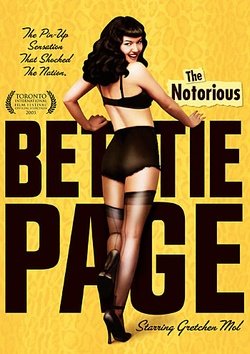
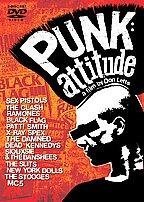
The Notorious Bettie Page lacks Punk: Attitude


It would be entertaining though not incredibly challenging to play "six degrees of Kevin Bacon" on these two movies; fortuitously I watched the bonus disc to Punk: Attitude the night after The Notorious Bettie Page, which helped me figure out what was disturbing me about the latter.

Both of these movies are highly recommended. Bettie Page is if nothing else a masterpiece of cinematography; filmmaker Mary Harron has done a great job of bringing an indealized version of the fifties into the viewer's space -- idealized not in a "Leave It to Beaver" or Back to the Future sense, but as actually remembered by those of us with a marginal temporal connection to the time. For me, it's the late forties and fifties as seen in my parent's photographs of their early married days, or in the beach movie or romantic comedies of the late fifties and early sixties. Most of the film is black and white, with occasional very stylized uses of color; for the most part, Nashville and New York are black and white, but we burst into a modern incarnation of technicolor whenever Bettie goes to Miami. This is one of the best examples I've seen of a filmmaker taking you visually into that period.

If anyone doesn't know, The Notorious Bettie Page is the story of a little Christian girl from Nashville who goes to New York to study acting and becomes the pinup queen of the late forties and early fifties. Under the aegis of Irving Claw, the aspiring actress is led further into the underbelly of what passed at the time as borderline porn, the bondage and submission industry. Who hasn't seen Bettie trussed up with a ball gag or in leather corsets and thigh-high black boots? She was the anti-Marilyn, the dark angel of the locker room. Her photos were sold under the counter at the newstand before the industry began to flower and loosen up right after Playboy began publication in the mid-fifties. Shortly after the industry legitimized, Bettie's career was over; Irving Claw was dragged before a Senate subcommittee (by another famous Tennessean, ironically, the McCarthey-esque Estes Kefauver, who has an office building here named after him) for U.S. Postal violations and his livelihood curtailed. As depicted in the movie, after not having to testify, Bettie seems to have either an understanding of or a guilt trip over her deeds and career, and flees back into the arms of Jesus. Movie over.

Gretchen Moll's depiction of Bettie, regardless of its accuracy, is riveting. You can't take your eyes off her, even when she is clothed (which as you might guess is not for all of the movie). As directed by filmmaker Harron, Bettie is a small-town girl and innocent nudist who is able to doublethink herself into ignoring the darker side of her industry. Let me caution you that the movie is based in part on a book I haven't read, so I don't know how historically or personally accurate the Harron/Moll depiction of Bettie is. The movie Bettie is not so much naive as accepting. At some point I think she realizes the fans of her artistic output are not as pure as she pretends, yet she accepts her role. Much of the mystique of Bettie Page over the years has been that even at her S&M darkest, she retains a look of fun; she never seems to think she is doing anything dirty -- more the naughty girl. However, the short film of the real Bettie stripping included in the bonus materials gives me a slightly different read on her face -- one more conducive with the film's rather banal allusion to possible childhood molestation. Unlike Gretchen Moll's Bettie, the real Bettie has a look on her face I've seen on people in similar roles in the real world.

The puzzling thing about this movie immediately after I watched it was the sense of something lacking -- something that appears in the face of the real Bettie. It is a very literal retelling of her life, literal not in the sense of being accurate, but of being very much an outside shot of its protagonist. Could Bettie really have been that unaware of her social impact and the archetype she helped create? Mary Harron certainly isn't, so it's up to the viewer to figure out why the movie was made this way. The missing link was made more missing for me last night when I watched the second disc of Punk: Attitude. Don Letts' film is the best documentary I've seen yet on punk. Normally, this kind of mass cultural overview disappoints me, so I was reluctant to watch the film, but Letts has done a great job.

Posted by Picasa


Punk: Attitude chronciles the history of punk from its arising from early rock and roll through the darker side of the sixties, through its inception through seminal bands like the Velvet Underground and the MC5, its natal period during the glam and glitter rock periods of the early seventies, and then its birth in 1975. Foreshadowed by the New York Dolls, my favorite rock and roll band of all time, punk found full expression in the Ramones, the Clash and the Sex Pistols, then after the Pistols' demise went underground into hardcore, and in my opinion, died. The fimmaker makes a case for punk's re-emergence in the Seattle scene in 1991, but I have my own prejudices against that era's icons like Kurt Cobain, perhaps the most overrated dead pop star of all time. Nevertheless, no one who lived through the punk scene of the late seventies and very early eighties can fail to be delighted by the film, and for the rest of you, it's a great history lesson. The film makes points with me by realizing the glam rock connection, including mention of obscure bands like Mott the Hoople along with the obvious like Iggy and the Stooges (but what about T. Rex? what about Slade? What about Wendy O. Williams and the Plasmatics? but I'm nit-picking).

The connection to all this is, watching the bonus interviews for Punk: Attitude last night, who appears, being interviewed along with Legs McNeill about the founding of Punk magazine (the apparent source of the genre sobriquet), but Mary Harron? So the filmmaker who portrays the relatively innocent Bettie was right there at the inception of the punk rock movement at CBGB's. Not being the most sophisticated film fan, I had to go online to learn that Harron was also responsible for I Shot Andy Warhol (a murky film featuring good acting by Bettie Page supporting actress Lily Taylor) and a very good film, American Psycho. I've always that although American Psycho was a very good film, it's nowhere as good as the novel by Brett Easton Ellis, because in the book you're never sure if all this killing is really going on. So in a sense, the film shares with Bettie Page the characterist of over-literal-ness.

One of the elements of the punk rock movement which has survived into the modern mainstream is the incorporation of leather and bondage gear. What began to emerge into the mainstream with Bettie came into the youth movement with the punk movement of which Mary Harron was apparently very much a part, then came to the forefront with Madonna, etc, and is now an element of the youth market. The children of the Senators who hounded Irving Claw out of business are now buying Bettie-style gear for their children.

Punk: Attitude is as an intelligent an interpretation of punk as could be tolerated, and in fact some of the interviews with punk icons like Paul Simenon of the Clash and the Buzzcocks, let along Henry Rollins, start to go over the top, especially when they discuss their literary influences; despite the validity of influences like William Burroughs, Graham Greene, etc., you have to wonder how many of these "influences" were picked up by the speakers post hoc in their increased free time since their punk careers ended. The Notorious Bettie Page is not quite as intelligent but is very watchable, though hollow in an odd way, sort of in the same way Good Night and Good Luck is hollow; there's something more here, some sort of missing ghost in the shell. Perhaps that emptiness is that true import of these pieces in tandem.

Monday, October 09, 2006

Nichiren Revisited

Sorry for the long time since the last post. I've actually had a good month, which partly means that I haven't been motivated to write about anything. So be forewarned that I may find myself writing when I have nothing to say. That actually may be the case with this post, or worse, this one may be ammunition for those of you who think I'm getting soft because I haven't blasted anyone or anything lately. Don't worry, it'll happen. This post regrettably (for that portion of my readers) is more evidence of insidious growing tolerance in my positions. Oh my. I'll be discussing the end of the world soon, so keep coming back.

Anyway, if you've read my previous posts on my own personal history in Buddhism, you know about my experience with the Nichiren sect, or more precisely, with Nichiren Shoshu. More specifically, I was a member of Nichiren Shoshu of America, which was then the American arm of the Soka Gakkai, the international lay organization affiliated with Nichiren Shoshu. I practiced with them from February, 1986, til August, 1988, in Albuquerque. The practice was a very powerful one which led me to form convictions and perceptions which are also realized in my current practice of Zen. The organization was very screwed up, and ultimately demanded so much of its members, and made such absurd demands, that most of us quit; and soon after, the Nichiren Shoshu priests excommunicated the lay organization and its leader, Daisaku Ikeda. I understand that the Soka Gakkai is still stumbling around out there somewhere, and there are some priests in Japan who still are Nichiren Shoshu.

To pause here, please note that I'll be revising my links section in the next few days. If you really like any of my links, please save them to your favorites, because some of them are coming out, though hopefully I'm keeping the good ones. For example, Warp Spasm's blog seems to have been hijacked by an internet drug provider. Whatever it is, don't buy it. Anyway, I'll be adding in some more Buddhist links and blogs, including some links to the blog and website of Rev. Ryuei Michael McCormick. If you want the authentic skinny on anything about Nichiren, please look to him, not me. The instigant for the reflective chance noted in this article was a meeting with Michael at the Atlanta Soto Zen Center's October sesshin this last weekend. As one of the senior students (Marcus) pointed out, I thought I'd never hear anyone chanting "Nam myoho renge kyo" in a Zen Center, but here it was.

Because see, the Soka Gakkai thinks Zen is the devil. Of course, they also probably think Nichiren Shu is the devil, and that's what Michael McCormick is a priest of. Nichiren Shu is the more orthodox branch of the Nichiren school, which is quite popular in Japan, I understand. Their practice to be honest seems a lot like the Soka Gakkai's, but they seem to have a more sane attitute. They don't encourage new converts to chant for money and cars. They don't think Nichiren (who was, historically a thirteenth century Buddhist monk and a rough contemporary of Dogen, main patriarch of Japanese Soto Zen), was the Original Buddha. They seem to be clear of most of the magical thinking which I find to be the main fault of religion in general, and to which Buddhism and even some aspects of Zen are not immune. Then again, that's what Rev. McCormich says, and he may be taking the high road.

I'm in danger of a slippery slope here. A year ago, I might have said that all religion is bad and delusional, and that Zen is good and not a religion. The main thing that leads me to modify this is a new perception of what is known as skillful means. "Skillful means" is used in Buddhism to explain the fact that many of the alleged teachings of Shakyamuni Buddha seem to contradict each other. Some of that seem downright superstitious. Apologists use "skillful means" to indicate that the Buddha spoke according to the abilities of his listeners. So most people can't do zazen, or shikantaza, let's face it. I tried it when I was about 23, and I couldn't do it. But most people can chant "Nam myoho renge kyo," and maybe after they do that for a while, they can sit zazen. That's a rough paraphrase of how Michael McCormick explained his personal progression (he's now studying Zen with Dan Leighton, another product of the San Francisco Zen Center who's now starting his own temples).

This perception came about with my conversation in dokusan with Rev. McCormick as to my frustration with the modern Zen communities I've encountered. We seem to be made up of middle-aged, overeducated white people, for the most part. In fact, Zen is included in the classification of Elite Buddhism, as opposed to the traditional Buddhism of the Asian peoples. Families with kids don't sit zazen with their kids, for the most part. Our Nashville Zen Center is mostly made up of married people whose spouses we never see. One of the things I miss most about the Soka Gakkai was its sense of community; families with children, mechanics and lawyers and teachers and students all chanting together. It really did feel like a big family; I miss it. At the Nashville Zen Center, we sit together, then go away. In a residential community it might feel like a sangha. As it is, it often seems frustratingly empty.

There has been a proposal put to the Nashville Zen Center to participate in a new Buddhist center in Nashville, to be shared by all Buddhists. I pretty much opposed it originally. At some point it becomes the Unitarian church, a bunch of people sharing nothing but the common name of Buddhists. But maybe we need this. Maybe some people need to wave prayer flags and participate in arcane rituals. Maybe some need to chant. And maybe someday when those people grow up they can learn to sit zazen. Hey, even if they don't, it beats the promise of a fiery death in exchange for a heaven full of virgins.

I don't really have a conclusion here yet, just a position in a process. I think the first time I mentioned the Nichirens, I drew a rebuttal from a Nichiren Shu follower who quite correctly took me to task for lumping all Nichirens in with the nuttier elements I'd encountered previously. I still don't understand objectively how chanting Namu Myoho Renge Kyo is any different than chanting Namu Amida Butus, except for the intent behind it, and if there's one thing I've learned from Brad Warner's school of Hardcore Zen and from Gudo Nishijima, it's all about action, not intent. Nevertheless, one of the erudite (young) Buddhist scholars I've met had just convinced me that to some extent I should take Nichiren seriously. So there. So you with the little flags can come in too, I guess.

I haven't updated the links yet. As they say in Alcoholics Anonymous, keep coming back.

Tuesday, September 12, 2006

Pluto and the Meaning of a Name

This whole Pluto thing has been cracking me up for weeks now, but it's been bugging me, too, and I finally figured out why.
As everyone knows, unless they've been on Pluto for the last couple of months, in August the International Astronomical Union in Prague voted to strip Pluto of its long-standing status as a planet. Pluto was discovered in 1930 and immediately named the ninth planet. It was originally thought to be largely than it is, and astronomers for years have pretty much agreed it should never have been named a planet in the first place. It's basically a big rock floating around in a weird orbit, usually outside the orbit of Neptune. On September 9, it was assigned the new designation 13430 by the Minor Planet Center.

What's great is the outcry over Pluto. The IAU was deluged with letters from schoolchildren protesting the "death" of this character, Pluto. Suddenly, the story of the planets, and the mental picture we all had of our solar system as this glowing ball surrounded by nine precisely-labelled little balls was gone. Of course, it was never like that in the first place; our system is a messy one, a big nexus of flaming gas surrounded by a small amount of debris orbiting it at great distances, mostly empty space and a bunch of rocks, eight of which now have the requisites the IAU has defined for planets. My point is that we collectively as a culture had given Pluto an identity. We named this rock after the Roman god of the underworld. Then again there's that dog. So for the children, and for all of us, suddenly one of the comfortable characters we've lived with all our lives is gone.

Now we adults know that Pluto is and always was just a rock, and the news stories have mostly been humorous because we realize that the redesignation of Pluto changes nothing. Yet we still have that feeling on the edge of our perceptions that something is missing. What this really should illustrate for us, in a fairly harmless and palatable way, of the value of a name, or more accurately, of the power of naming something.

Someday I'm going to have to address the whole animal rights/vegetarianism issue, a quagmire I'm not looking forward to. But for now let's just stay close to home and talk about our pets. Readers of this blog know how attached I am to my old cat, Ms. Johnson. If you check the archives for last year, you can find pictures of Stephanie's dog Gizmo. They get treated like people. If you scroll to the bottom of this blog, you can watch a blurry cell phone video of two of my dad's beagles, Mona and Lucky.

Mona and Lucky are excellent illustrations of the power of a name. My dad has had beagles for most of his life. For the most part, these old country guys don't treat their dogs like pets. His beagles have names because they are registered purebreds, but until recently they rarely got called by them. They live mostly in elevated cages in a pen behind his house. If they're lucky they get let out a few times a week to run rabbits, then back in the cages. But suddenly, for whatever reason, he asked me to name Mona about seven months ago, then Lucky got a name, and the two get preferential treatment; they get to come out and play like pets. Now some of the older dogs have acquired more personality, in his eyes; they get called by their names and even old Sam's been let out to play with Lucky. Suddenly these dogs exist.

You should realize, these old guys are known to shoot beagles in the field because they won't perform. They've been treated like, well, animals.

Now broaden the scope a minute. I would never consider eating Ms. Johnson (she'd be old and tough anyway), but there are millions of cats everywhere in America, many of whom are feral, and many of whom live like animals. They starve to death, are tortured to death for experiments, or are generally neglected and/or abused. Some actually do get eaten. I can't take all of this upon my head. I can't be responsible for the fate of all cats. I've made the choice, conscious or not, to give Ms. Johnson a name, to respect her personality. She's a person to me.

The bottom line is, and I'm sure the more astute of you are already waiting for me to spit it out, these creatures, like Pluto have been anthromorphized. Go look at your old English textbook for poetic devices. In other words, these pets, like Pluto, have been endowed with human identities and personalities in our little conceptual worlds. Ms. Johnson has no more personality than the street cats I ignore (OK, I can still look at cats whose names I don't know and wild animals like squirrels and temporarily endow them as characters with personalities without naming them, but that's just an extension). The real lesson here is about how we define our realities. Ms. Johnson is real because I make her real, in my world. To some Asian chef somewhere, she is just overage meat. Gizmo, on the other hand, is porky and might be quite tasty. Pluto is a rock.

This is really not about animals, despite the correllary that PETA is basically a result of category errors in human thinking (go back and find the entry on Gilbert Ryle; Wittgenstein to follow). The lesson is about how we view ourselves. Buddhism teaches that the self is not real; it is our little minds' conceptualization of how it perceives and deals with an amalgamation of traits and really, behaviors, actions, that we can deal with in our frames of perceptions as entities. All that is really useful; people act like people, so it helpful for us to think of them that way. But the bottom line is, they're not real. You're not real in the sense that you're any different from me or Ms. Johnson or Pluto, exception by definition. Your definition, and the cultural one you share with the other self-defined humans. You're a useful conceptualization for the material world. Your life is a story you tell yourself. Your whole reality is like that. Tell yourself a different story and everything changes.

So why is this useful? After all, we live the way we do for a reason. Your brain and your conceptual reality can only handle so much input. I can't shake the hand of an arbitrary batch of attributes, but I have the shake the hand of the guy I want to offer me a job today. I can't be responsible for the life of every stray cat, but I can continue to make Ms. Johnson special and allow her her personality. This is why PETA is a path to despair; the responsibility to save all beings is overwhelming, and one quickly learns to start with that same non-existent self, to get it done. But we can extend the logic the other way, into the larger real world, and maybe benefit from some compassion. It is a little odd that your pet's life means more to you than the lives of those millions who died in the tsunami. Why are those who died in the World Trade Center revered, but the thousands murdered by our neo-Fascist government, in the Middle East and otherwise, are ignored? Because we can make the ones close to us real, and the ones far away, most of whom we have relegated to less-than-human status by demonizing them, are de-anthromorphized, made unreal. We couldn't let ourselves or our "heroes" slaughter them otherwise, could we? How about the millions we put in prison?

In fact the animal rights people have a point. Pigs are as intelligent as dogs, scientists tell us. Yet Gizmo eats pork. We have made our definitions and live our realities by them. I'm not saying this is wrong; we just need to realize that our definitions are user-based and always somewhat arbitary. They are necessary to live our cultural lives as humans, but the attributes we stick on animals and planets are not intrinsic in their existence. They are just part of our labeling process, and the labels can be changed, or ignored.

So is Deuce Rufus more or less real than I am? You choose.

Friday, September 08, 2006

Silly Advertising, Gone; and a Comment on Content

Early this morning I finally broke down and took the Adsense link off this blog; if you look, you'll notice it missing, immediately above. I think I put it up there late last year not long after I started this blog, not so much in the hope that it generate any real revenue, but just to see what ads would be placed. The way it works is, when you first sign up for Adsense and add the html code into your template, it gives you a bunch of public service ads; but after the webcrawlers start to cover your site and pick it up, you get ads which are targeted for the content of your site -- by key words, I guess. So I wanted to see what ads would wind up on a blog which consists mostly of anti-totalitarian politics and Zen Buddhism. It's been amusing; at least half of the ads were for things that were explicity or implicitly disparaged in the content of the blog entries I was writing. But at long last I got tired of giving these weird things ad space on my space (although it's free space), and occasionally I worry about whether people who are new to my writings actually might think I was advocating all this crap. So it's gone.

Oh, and in case you're interested, my total earnings for the entire run of the ads is $11.11, of which I will probably never see a penny; I understand they only start to pay at $100.00. If anyone out there knows how to make them cough up my eleven bucks, please let me know.

You'll also be amused to hear that in the course of revising my template to get Adsense out, I screwed up the html and dropped the entire right column to the bottom of the page; then it took me at least half an hour to find the offending code and get it out (it was an extra html command). By the way, I think that's probably what's been wrong with Brad Warner's blog site the last couple of months, so Brad, if by any chance you read this....

One more thing. I'm quite aware that some of you reading this blog started reading it for its anti-Bush orientation, probably, and lately you've been getting mostly Zen stuff. That's just because it's where I've been and where I've been putting my energy. I seem to have gotten tired of beating my head against the wall, and I suppose for the most part I've been preaching to the choir, anyway. I't really just so obvious and apparent what's going on in this country and the world that I don't see how anyone can not see it for what it is. And without going off on a huge digression, what helps me to see more clearly, on this and every other matter, day by day, is my zazen practice. And no, I'm not advocating that everyone practice zazen or become Buddhist, although some people I highly respect and call my teachers say that yes, Zen is for everyone. I certainly respect that opinion, but I won't say that myself until and unless I come to truly believe that through my practice. But I will say that whatever you can do to see and think clearly, do it now, because now is the time. In the current state of the world, we can't afford to live in illusion. The best analogy I can think of is, do you want to be drunk or stoned when the storm troopers kick in your door, or do you want to be able to handle yourself at your best?

So my less specific advice is, clear out the cobwebs, get your head on straight, and walk erect through the darkness, 'cause that's where we're heading. Although I would love to believe those optimists who think the world is entering into a better age, this contradicts everything I see around me. I think it's pretty obvious that things are gonna get worse before they get better. Be prepared.

Wednesday, September 06, 2006

Illumination Mountain

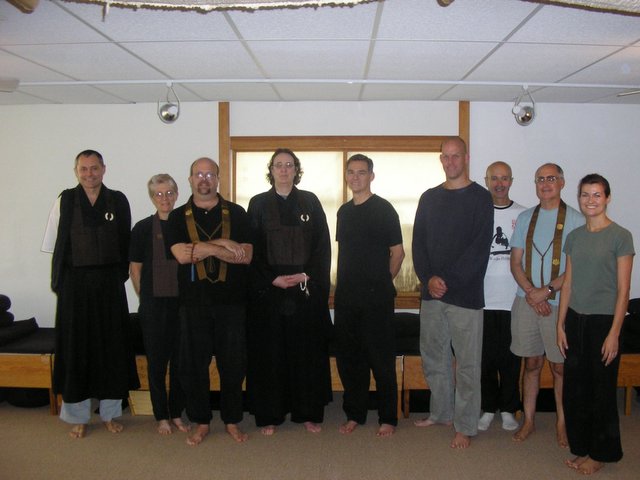
On September 3, 2006, at the Atlanta Soto Zen Center, at about 11 a.m., my initiation as a Zen Buddhist of the Soto sect took place as scheduled. In the absence of the abbot, my Zaike Tokudo ceremony was performed by three senior students. I had been a little apprehensive about that, but afterwards I came to appreciate that it was a real gesture of acceptance by the sangha. Cherry, Terry and Phil, I can't thank you enough.

Thanks also to my friend Nat who made it down from Nashville to attend the entire sesshin and witness the initation (actually he was already in Atlanta for business but was demoted from the Weston to sleeping in the Zendo for the occassion, where he battled imaginary fleas). That's me third from left, and Nat fifth from left. Terry, the ASZC tenzo (cook/innkeeper) is on the extreme left; Cherry is between Nat and me. The others are all students or disciples at ASZC or elsewhere in Georgia.

As part of the ceremony, I received a wakesa (that's a symbolic robe for lay initiates, the ribbon-like thing around my neck in the picture), some beads, and my Buddhist name, Kozan (diacritical mark missing in this font), which translates as the title of this blog entry. I'm not yet sure about all of the implications of the name, but it sounds heavy. I spoke briefly to the ASZC abbot yesterday; I'd thought he was in on the selection of the name, but he sounded surprised when I told him what it was, and said it was a lot to live up to. I guess I need to grow into it. I thought maybe they picked it because my head is shiny and I need to lose weight. Oh, well. Typically, the Buddhist name is used as part of one's name in relation to sangha activites (i.e., this month's sesshin was led by Honen Phil Hutto). Unfortunately, the pairing of any Japanese name with "Bob" sounds weird. "Kozan Bob" sounds like a Japanese movie cowboy.

There is a lot more to tell about the initiation, but I think I'll let it leak out over time. I have a feeling the implications of the vows will taking some working out, and working on. In a certain sense because the vows aren't commandments, but ongoing commitments to action, the ceremony itself is ongoing. I'm quite aware people go through ceremonies like this all the time and don't take them seriously. I guess it's all a matter of what you want to make of it.

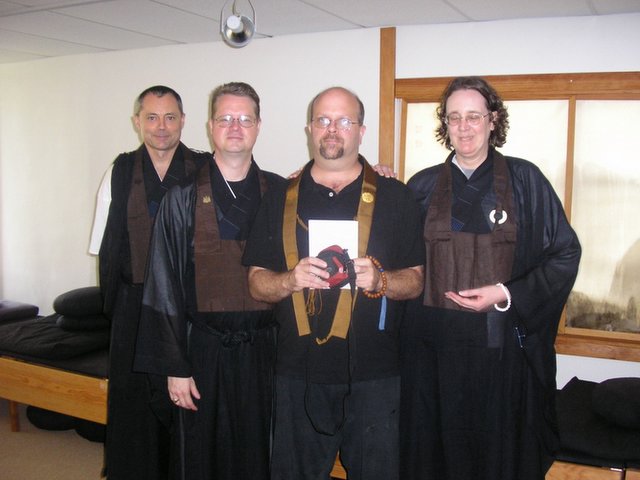
Oh, Phil is missing from the pic above because he took it. He appears below. No, I don't know why I'm clutching my camera case in the bottom pic; tokudo shock, I guess. Oh, again, the woman on the far right in the top photo is Kate Morrissey, a guest from the Athens Zen Center, who took the pic below (me and the senior students after the ceremony). I've added a link to Kate's web page in the Links section to the right; Kate is a singer/songwriter/pianist who'll be peforming in Nashville next month, among other places. Check out her music and tour dates on the page.

More to come.

 Posted by Picasa

Friday, September 01, 2006

Meetings with Rev. Hye Wol Sunim

Posted by Picasa Rev. Hye Wol Sunim was first ordained in Sri Lanka in 1977 and took robes in the Korean Zen tradition in 1984. Rev Sunim studied with Buddhist masters in Sri Lanka, Thailand , China, Australia, Taiwan, Korea, and Japan . He arrived in the US in 1991 and is currently creating a Meditation Center in Acton, California. He translates Pali text and teaches the early Pali canon.

Over the course of the last year, I have had the fortune to have several meetings with Rev. Hye Wol Sunim, who just likes to be called Sunim. I have noted his recent presence in Nashville in several recent blog entries. To recap, I first heard him speak when he represented the Nashville Zen Center at the (then-) annual Buddhist Fair here as a guest speaker. More recently, he has been in town for over two weeks as the guest of one of our NZC members, and I have attended several "sits" with him and have had the opportunity to speak to him alone or in small groups on several occasions. What has emerged is an impression of a remarkable man who has lived a life steeped in Buddhism, to an extent most of us could not imagine. His dedication is more than inspiring, but it has taken me a while and a few conversations to figure out what his life and teaching really is, and it is inspiring, if not something any of us could hope to duplicate.

My understanding from reading what I can find on the web is that Sunim has received transmission in two traditions, some kind of Korean Zen (I am fairly ignorant about the different schools, although I know the NZC rituals are based on one of them, which I think is Kwam Um) and Vipassana (a Theravada tradition which is most familiar to some of us through insight meditation). The blend of these traditions is not that unusual or incompatible; the meditation practices of Zen and Vipassana are more similar than those of any other two Buddhist traditions I have encountered. In fact, an offshoot group of the NZC (which I believe is called One Dharma and meets elsewhere here in town) is, I think, based on this same blend. What makes Sunim's teaching and work more remarkable to me is my discovery in my latest conversation with him that he is not so much trying to blend two traditions as to go beneath and behind the traditions to study and teach the original teachings of the Buddha. To the extent that he does this, his teaching is both outside of either tradition and the start of its own.

I am relatively certain that Sunim's method is not unique. After all, he is a Pali scholar and a Buddhist scholar, a man who has the ability to go back and look at the Sutras on which all schools of Buddhism are allegedly based, in the purest form in which they can be ascertained. My understanding from my conversations with him is that he certainly respects the traditions of the schools of Buddhism for what they are, but he thinks that the teachings of the Buddha are beyond all these traditions; that the traditions are merely the stepping-off point, the discipline which begins the road to final realization. He has had the ability to go back and read the sutras in their earliest extant forms and from those derive what he believes to be the true teachings. My own Pali being weak (i.e. nonexistent), I am unable to verify or quarrel with any of his opinions on this, of course. I do admire the devotion and purity of this approach.

Even I know there are problems endemic to trying to ascertain the teachings and intentions fo the Buddha Gautama from these texts. First, he lived to be 80 (reputedly dying of bad pork, by the way) and taught for 50 years. His teachings, which comprise the sutras, are as numerous as the sands of the Ganges. Pretty much all of the schools of Buddhism have seized on one of these sutras as the "highest" teaching of the Buddha, relegating all of the others to "provisional" teachings intended for those of limited understanding. Some schools, like the Nichiren schools have extrapolated beyond the sutras themselves; Nichiren contended that the title of the Lotus Sutra (Myoho Renge Kyo) was itself the highest teaching. Zen contends that the truest teaching of the Buddha occurred outside of the sutras, a wordless transmission from master to disciple embodied in the passing of a flower to Mahakasyapa.

Then again, there is the problem of preserving texts. Even when we get to the oldest texts we can find, how do we know they are accurate? How do we know which were authentic teachings of the Buddha and which were not? Even with my limited knowledge of the subject, I know that Buddhist scholars admit that many sutras could not have been written in the lifetime of the Buddha. The same problem exists in most or all religions. Modern Christianity really cannot be said to have existed before the Council of Nicea in 453 A.D.; before that, Christianity consisted of multiple inconsistent sects, some of which taught doctrines which were absolutely refuted by the Council, and some of whose doctrines differed from the teachings which came to be accepted and embodied in the Bible by minsicule degrees about which only a scholar or a fanatic could care. The political motivations of those who chose what came to be orthodox doctrine can be (and is) debated ab nauseum, but are way beyond the scope of this blog entry. Christians really should read the Aprocrypha to understand more about the choices that were made in ascertaining the "true Word of God," and by whom.

Of course I realize, as I prepare to leave later today for Atlanta for sesshin and for my initiation on Sunday, that Soto Zen is something that evolved after the time of the Buddha; Chan Buddhism originated in China, became something different in Japan, and has become a new animal in the United States, whether it wants to admit it or not. Nonetheless, I am drawn to it as the school and discipline which works best for me. I also see a clear differentiation between Sunim's life work and the teaches and practices of those who want to combine traditions. Like Brad Warner, I find it amusing when an American teacher claims to have mastered three or four traditions, all of which their true adherents devote their lifetimes to and rarely claim to have mastered, by the age of thirty or forty. The martial arts are analagous. Sunim is different, and impressive thereby; he is not combining Zen and Vipassana, but rather going behind them to determine what the original teachings were, to the best of his ability, and his ability is more than mine will ever be. I am 48 years old. I will almost certainly never learn to read Pali. I will most definitely never sit is week-long, 24/7 sleepless sesshin. Sunim has done both of these, although he now thinks that the later is not useful, a counterproductive form of asceticism.

All of the above (my understanding of Sunim's work) came as a result of my question to him about the importance of posture in zazen. Soto teachers that posture is paramount, which comports with my own experience; I had noticed that in the lesson he had just given for some rank beginners, he made no attempt to correct their really lousy posture. Bad posture in zazen is rampant in the NZC, and is almost certainly a result of the fact that most of the newer members have learned to sit without correction and without teachers. My posture is not the best, but it gets worked on every time I go to Atlanta. Sunim says that the posture is the means to an end; a lot of Soto people would say that the posture is in itself both the means and the end. In typical enigmatic Zen fashion, from my own limited experience, I would say that both are true.

One thing I am sure of is that all of us who are students need teachers; not cult leaders, not masters, just someone to give us feedback on our progress. Coaches, if you will. It's a life thing; you can't see yourself from the outside. Yes, you need to rely on yourself and what you learn for yourself, ultimately. If your teacher's teachings begin to contradict your own experience, you must go with the truth you perceive, and reject those teachings and perhaps ultimately that teacher. Yet is is assinine to continue to reinvent the wheel. It is very good to have help along the way. Soto Zen provides that for me at this time, but it is more than helpful, it is deepening, to meet other teachers along the way. For this, I will always be grateful to Sunim. He will have his own followers; I believe he has blessed my pathless path, and whatever it is worth, I would similarly bless his.

Now stop reading and thinking about this and go sit.

Tuesday, August 29, 2006

Prelude to Initiation

Just a note of resolution to the petty angst of the previous post. As it turned out, Rev. Sunim's visit has turned out to be productive in a lot of ways, and even if the bulk of the Nashville Zen Center can't see it to do more than attend some Saturday meetings, the one I attended last Saturday with Sunim and a larger-than-usual group (including one new guy who definitely came on the right day) was very good and helped ameliorate my previous gripes and reservations. Plus, I got a chance to spend some time with the monk himself, and came to appreciate his sincerity and experience. It doesn't hurt that he came to be and made a point of personally approving my Atlanta connection, and asked me to try to make the connection for the rest of the group, which has been my agenda for the last four or five months anyway.

Plus, this weekend's Labor Day sesshin in Atlanta is all sorted out, at least for me, and I have resolved to go ahead with my Zaike Tokudo ceremony at 11 a.m. Sunday morning, September 3. The Tokudo ceremony is a Buddhist lay initiation ceremony at which the initiate formally enters the Buddhist path by taking refuge in Buddha, Dharma, and Sangha, and adopting the Three Pure Precepts and the first five of the Boddhisattva Precepts. There's also some symbolic shaving of the head and such. The ASZC page on this ceremony can be found here: http://www.aszc.org/ceremonies/Jukai.html, and the text of the ceremony is http://www.aszc.org/ceremonies/JukaiCertificate.pdf.

This ceremony will formally enter me into a Zen community at long last, although it is a community which is geographically over four hours away. That's OK; I've been around them enough to know that it's a community I want to belong to. I probably should be a little antsy-er than I am about taking vows. I got lucky enough never to take the one most people take, after all. But I have taken a couple of sets of "religious" vows I didn't adhere to, and while I'm not exactly consumed by guilt, I'm entering into these with a sense of conviction I haven't had before.

First, please realize I've been baptized into the United Methodist Church, twice, and even joined the damned thing in junior high or high school, I don't remember. I'm not sure why I ever went back to church for a while in adolescence, since I'd known that their beliefs were a crock of shit since I was no older than nine. I still have no idea how anyone with a rational mind could ever swallow that garbage, and I never did. Peer pressure, I guess.

Then in 1986 I went through the formal initiation into Nichiren Shoshu Buddhism and joined the Nichiren Shoshu of America, which after my departure in 1988 became the Soka Gakkai of America after its leader was excommunicated by the priests of Nichiren Shoshu. At that time I received the Gohonzon, or great object of worship, which I still have around here somewhere. Looking back on it, I don't know why I embraced that Buddhism of nam-myoho-renge-kyo as I did; I don't think I ever believed that stuff either, but I was so unconsciously eager to embrace some form of Buddhism that I jumped at the chance to become involved. I think I had some sense of having abandoned Zen in San Francisco earlier in the decade and being unable to go back to it. I don't know why I didn't find a local Zen group or the Tibetans; they were surely there. I did take a stab at Tibetan Buddhism in 2004 before I found the Nashville Zen Center, but by that time my appetite for that kind of silliness had diminished. That's all been covered in earlier entries, and I'll leave it alone.

Anyway, a couple of my friends from Nashville should be in Atlanta for my ceremony which is nice, and I only regret that the Hojo (abbott) will be unable to meet them, and vice versa. However, I get initiated without having to return to Atlanta the next weekend, and I trust the students. They have built a nice Buddhist community, and both Sunim and Brad Warner have recommended that I pursue the connection for the whole group. So I will.

Anyway, these vows. What do they mean? I won't analyze them in detail here, though I may do so later. Taking refuge in Buddha, Dharma and Sangha are obvious. The three Pure Precepts are to not do bad, to do good, and do good for others. Okay. and the first five Boddhisattva precepts are don't kill, don't steal, don't engage in sexual misconduct (as if that were a problem), don't lie, and don't cloud the mind with intoxicants (that one actually translates, I understand, as don't live by selling liquor).

As opposed to the Christian Commandments, violating these precepts will not win me a ticket to hell. The precepts are meant to serve as guidelines for social rules in a Buddhist community to make it work, and in the individual sphere to keep out conflicts that will interfere with the benefits of practice. But vows are vows, and I don't do that kind of thing lightly anymore.

I think I mentioned before my friend with 25 years in AA who ventured his opinion that a lot of people who succeed in AA do so by using AA as an excuse not to drink. Unless you've been close to the situation, you won't understand what that means. But the analogy for the instant situation is that if you want to change your behavior and live differently, taking public vows to that effect may be a very effective crutch. We'll see.

Thursday, August 24, 2006

More on the Twisted Path

Posted by Picasa It just doesn't get easy, does it?

This photo was taken at the same time as the one which introduced my March 13, 2006 entry that I called "The Empty Well." If you're new to this blog, you might want to read that one; in my opinion, it's one of the better ones, and a good intro to this piece, as it concerns my frustration with the current state of Zen Buddhism in Nashville and in my life.

Luckily for me, things changed after that. About three weeks after that I took it upon my self to visit the Atlanta Soto Zen Center, and found a sangha and an environment which better suited my appetites to go a little deeper into living with Zen that the weekly coffee klatsch that NZC seemed to me to have become. All this has has been chronicled herein; this is the update.

Currently two events which could either or both be major are affecting (or not affecting) the Nashville Zen Center. First (from my perspective), the NZC has cancelled its fall retreat, based primarily on its belated realization of its poor showing last March and the unwillingness of a sufficient number of members to commit to anything (and upon the unavailability of its usual leader, Sandy Stewart of the North Carolina Zen Center, an excellent teacher who perceptively has found something better to do with his time). In lieu, it appears or has appeared that a number of NZC members are to accompany me or themselves to the ASZC for its September sesshin, September 1 - 3. Problems here, too; the main point of this trip was to meet the abbot of the ASZC, Michael Elliston, who has just returned from a 90-day or so stint in Austin, for reasons to0 complex to go into here. Now it appears the abbot will be out of town again, which doesn't bode well for the interface I had hoped to finally begin between the two groups.

At any rate, at the request of the ASZC tenzo I posted a couple of days ago on the NZC Yahoo group for confirmations for the Atlanta trip. No responses so far. So we'll see. As you might guess, my expectations are low.

To recap my March experience and blog entry, at the spring retreat for the NZC, exactly three regular NZC members (and one occasional member, who visited for part of a day) showed up; there were three other visitors. This was for the retreat led by Brad Warner, the man I credit with bringing me back into Zen after about 25 years, whom we brought in from California. The three members who attended were Nat, Jennye and I, who all busted our butts to make the retreat work for the members who didn't bother to attend. I won't beat that dead horse any more.

But now Jennye is having a similar experience with a guest she has invited in. Each year (until this year) the NZC has participated in Nashville's Buddhist Fair, which is or was a cooperative effort between the Zen group, the Tibetan group (actually, two of them) and a Vipassana group.
It seems to have been the tendency for each group to invite an out-of-town speaker to the group, and last year we lucked into having a Zen teacher in town who represented us. The Rev. Hye Sunim, a monk trained in Korean Zen as well as in other traditions, appeared and spoke for us, and met with us for a dharma talk at our next meeting. Sunim (as he likes to be called) has been teaching in Los Angeles, and is at this time again in Nashville and available to the NZC.

So everybody at NZC was excited that Sunim was coming. Everyone wanted to meet with him. He sat with us (with them; I was out of town) last Saturday at our only remaining weekly meeting, and will do so again this Saturday; reports are that the meeting has slightly more than usual attendance. Yet as of yesterday, NZC members had failed to attend any other functions with him, despite intensive and repeated notification. Luckily, members of another Buddhist group, ironically an offshoot of our group and with members also interested in Vipassana, have been attending. [An odd sidenote: the NZC when it meets is at least 90% male. I dropped by to see Sunim Tuesday night after work, and was the only male in attendance. Buddhism for women? I don't know what it means, if anything, just found it interesting.

On the other front, I am scheduled to finally undergo an initiation ceremony in Atlanta on either Sunday, Sept. 3 or 10. At that time I will finally, after years of practice off and on, adopt the precepts and the layman's vows appropriate to Zen. Obviously this is something I am looking forward to, as in case it means not just formally committing to Buddhism but also adopting or being adopted by a sangha. But even this has gotten complicated. The ASZC normally holds the ceremony twice a year, in September and March. I am told that traditionally the ceremony is held at the end of a monthly sesshin, at which time the initiates and the sangha have been sitting fairly intensively for a day or two. Next month, the sesshin is scheduled for the first weekend of the month as usual, but the ceremony was scheduled for the second Sunday. None of the senior teachers seemed to know why.

Now of course we know why; the abbot was scheduled to be out of town, which was apparently unknown to some or all of the students. I had had some discussions with the tenzo (innkeeper) to the effect that it would be nice to have the initiation on Sunday, Sept. 3 so that I didn't have to come to Atlanta two weekends in a row, and so that should any NZC members really make it to Atlanta, they could be there for it. To shorten this up a bit, it appears that largely for my benefit, there are now two initiation ceremonies scheduled, one for the third and one for the tenth. I'm honored, of course.

When I first started writing this blog entry yesterday morning, I had written the abbot and the tenzo and not yet gotten responses; after hearing from them, I'm going ahead with the initiation on Sept. 3, which will be performed by one of the students. I don't want to insult the students, and hey, it's just an initiation, not a dharma transmission or something. I'm just proud after all this time to be taking official vows and refuge.

I'm quite aware that this entry loses focus at the end; sort of like a real blog entry, huh? Yesterday I was agonizing a bit over whether I had insinuated the ASZC into compromising their schedule, and if my connection with the abbot and the school had been thereby compromised somehow. Today, I'm not worried about it.

Hey, and night before last my AC went out, and now it's fixed. Maybe that was the whole point after all.

Tuesday, August 15, 2006

Not Ready to Make Nice


It's hard to find an artist with integrity these days. Here are three.

It just shows you how shallow country music radio and country music fans are, to think that a group featuring the best female voice in the industry would be blacklisted for making one honest and perceptive comment about the Nazi whore who is the titular head of the US government.

Did you ever think how easy it would have been for the Chicks to dump Natalie after her comment? But they stuck together, and thereby earned my perpetual respect and affection.

Anyway, for those of you who are tired of talentless whores like Tim McGraw and Faith Hill, here is some real music. If you don't like it, go find another hobby.

Monday, August 14, 2006

OK, Here's That Poster

Posted by Picasa Hey, guys, this is the poster I wanted to include with the blog entry entitled, Fear, etc., below. I have no idea why Blogger's photo upload feature stopped working all of a sudden; in fact, apparently they don't either, or they don't care, or are just plain stupid.

Thanks to Dennis at warpspasm for suggesting this (picasa2). Anyway, go rent or buy this movie. Then talk to me.

Sunday, August 13, 2006

Deuce and Billie

Das ol Deuce

Friday, August 11, 2006

Fear (and Some Random Thoughts)

"One man's terrorist is another man's Freedom Fighter." Ronald Reagan (?) (somebody find me the source of this quote).

I just finished watching V for Vendetta on DVD (if you didn't read my March 26 post, go to the archives for my first "review" of it. As lie builds on lie in the media, the movie seems more true-to-life than it did at first viewing at the Imax; as usual when I watch a big-screen movie for the second time on a smaller screen, when I already know the plot and won't be so overwhelmed by the visual effects, I appreciate a great movie even more. I still wonder why Alan Moore wanted his name removed from the final production. Is it because his graphic novel's backstory was in Thatcher-era Britain and the movie's begins in our present time? Or have his political views changed? Is he a Blair-ish toady kissing Bush's ass by proxy? Or is he just afraid of possible repercussions if the government clampdown is successful across boundaries? There's just no way to know.

There are other things I caught tonight that I missed the first time. Parallels, foreshadowings etc., but maybe if I don't say too much you'll be inspired to watch it twice, yourself. I may have more to say about the movie after I finish watching the special features on the second disc, but I doubt it. If you haven't seen it, go rent it. Now.

I occasionally find myself not blogging because I think that by now you must already know what I think about everything from what I've already said, but then I realize that's an idiotic position. That's just me thinking my perceptions and trains of thought must be universal, but in rational moments I realize that's really not the case. So I need to point out some things which you may or may not have thought already, and may or may not agree with. Obviously, just about all that's on the news these days is about the supposed terrorist plot in London which was supposed to result in many American planes being bombed into the ocean. Although that's all we hear (or you hear, since I avoid watching the news as much as possible), I really don't have much to say about it. Frankly that's because I don't believe a word of it. Now, I'm not saying it's not all true, or at least based on a real incident. I'm just saying that as far as I'm concerned, the mainstream news has become little more than a voice for government propoganda, and I have no idea which is true or false if that's my only source. OK, I believe the sports scores. Usually.

In the movie, one of the more dramatic (and frankly problematic) plot arcs has to do with V's rescuing/kidnapping Evie, then imprisoning and torturing her until she loses all fear and thus becomes free. That whole fear/freedom thing is sticking with me. It occasionally becomes uncomfortably clear to me that I'm writing about the growth of New Fascism in America, and those Fascists can read this, and that this is exactly the kind of thing people get hauled away for when the Boot come Down. I try to take comfort in the fact that there are a lot of people out there speaking out and writing against the growing oppression, and then I remember that America has a lot more room for camps than Germany ever did. So at some point it comes down to using what talents I have to do the right thing. If there's one thing my Zen sitting has taught me as much as V for Vendetta has (heheh), it's that that last inch of integrity is all you have in the long run. Yes, if one speaks out against the oppression, one risks the loss of all one has. But hell, I don't have that much, and we have to remember that all our property and possessions and accomplishments, all that constitutes the social platform on which our existence (or the existence of our personal indentity) stands depends on the continuted existence of a free society. Do you want to live as a scared little rat in a Nazi state? I've decided that I don't. Your decision is yours to make.

Fear keeps us from living meaningful lives. Fear that we'll go to hell if we don't choose the right religion. Fear that unknow enemies, be they "terrorists" or whatever will kill us all if we don't give up all our rights in the name of Security.

Sometimes Fear wakes me up in the middle of the night. That only happens when I don't feel right about myself. It happens when I don't do the right thing, and when I'm worried about paying the inevitable consequences. Because when I do what's right, I have nothing to fear, because I've done what I need to do to preserve that last inch of integrity, that make me me, that keeps me truly alive. Now, no one does what's right all the time. If we always did what's right, we'd never eat the flesh of animals. We'd never pollute our consciousnesses with drugs or alcohol. Most of us would weigh less. But some things are more important than others. Going to another country to kill people who've never hurt you, that's an important decision. Backing the invasion of yet another country by Israel, a country we set up in the 1940's (in the wrong place in the first place; more on that later), that's an important decision.

So how do you know what's important and what's not? Check your fear. Check yourself from the inside out. Draw an imaginary line from the base of your spine to the crown of your head, and see how far from that bowstring your fear resonates.

See how you sleep. Then you'll know.

Thursday, July 27, 2006

World at War: Faith and Clarity


Warp Spasm writes in his latest post: As the world continues to crumble around us I am feeling an incredible sense of impotence. I waiver between rage and resignation. If I could I'd grab all these so-called world leaders by the lapels and shake the living shit out of them. How can they continue down the road to ruin? Why aren't people everywhere rioting over their lack of influence and power? Impotence?

It seems to me, they are. That's what's going on in the Middle East, and in parts of Europe and Asia, and almost everywhere but here; the riots here have been supressed by something that seems like a drug released into the air (it's not literally, but it may as well be). The world is at war, and it's not a war between Christianity and Islam, or capitalism and terrorism, or any of those lies. It's a war between ignorance and ignorance; but in this case, part of the ignorance, the ignorance of the suppressed, the tortured and the starved, is understandable. Familiarity with Maslow's hierarchy of needs shows us why most people in this modern world have no time to develop "higher values," which we often forget, can easily be a bourgeois affectation. The willful ignorance of the oppressors, which in this case is the Bush cabal and its puppets, is not so easy to forgive. It's still ignorance -- the mistaken belief that the their heinous acts and execreble lives can be of true benefit to them, as they artificially set themselves apart from humanity and existence -- but it's impossible to forgive. This willful ignorance is the closest I can get myself to believe in damnation.

...Things fall apart; the centre cannot hold; Mere anarchy is loosed upon the world, The blood-dimmed tide is loosed, and everywhere The ceremony of innocence is drowned; The best lack all conviction, while the worst Are full of passionate intensity. - William Butler Yeats.

Often these days, I feel like I'm walking around in a sci-fi movie. Often it seems to me that humanity is divided into two subspecies: those who can see their hands in front of their faces, and those who can't. The division crosses all lines of education, age, culture and intelligence. There are old people, poor people, even people who I wouldn't considered stupid at other times, who can see the current world situation for what it is. Some of my good friends, including the educated ones and the ones who have no reason to love the oppressors, can't. There seems no rhyme or reason to it.

I would like to thank my Buddhist practice as renewed in the last couple of years for my particular ability to see -- and in this case it's pretty much a lifting of the veil -- but I can't. As loathe as I am to speak of the particular benefits of Zen practice, it's obvious to me at this point that clarity is the chief one, at least for me. But of course it doesn't take zazen to see the Bush Cabal for what it is, most of those who see it have never sat cross-legged. One of my best friends, a sober alcoholic for thirty years, once remarked to me that for a lot of people who stick with AA, it's an excuse to remain sober. Perhaps for me zazen is an excuse to see clearly.

When I say clarity, I don't mean everything is clear all the time, or that there is some new hidden depth to the world that wasn't seen before. Things are just seen as they are. I'm gonna stop trying to talk about it, here, for now. It just can't be done.

The last sesshin I attended in Atlanta was taught/led by one of the students in the absence of the abbot, and he listed the theme for the weekend as "Faith." I'm sure this was a consciously-perceived dissonance for Steven, as he was quite aware that running from blind faith and the ignorance fostered by religion brings most, or a lot of, people to Zen in the first place. But there is a kind of faith in the consistent practice of zazen -- faith in the process, not in the goal. This faith is more of an empirical finding, backed up as the experiment leads to confirm the original induction. As long as the process works, we must be willing to follow the process wherever it leads us; I have no idea what perceptions I may have tomorrow, but I have must have faith in my willingness to be true to them. Ultimately, I think, the journey leads us right back to where we sit, and the destination is the same as where we start, and not. Enough of this babble; it reduces the experience.

You can read Warp Spasm's quote in context at his blog by following the link in the column to the right. If anyone empathizes with his rage, and mine, validate yourself by reading this article titled "Peace Prize Winner Could Kill Bush," also in a link to the right. Also, the movie I was trying to remember was "They Live," with Roddy Piper. Only people with special sunglasses can see the aliens. Get it?

Wednesday, July 26, 2006

Strange Disappearance

Strangely enough, when I tried to load this blog this morning, the 911 Eyewitness video failed to load. I can't imagine why. Since then, the video has begun to load again normally; but if you haven't seen the movie or haven't had time to finish watching it, and the movie in the previous entry won't load, try this link: http://video.google.com/videoplay?docid=-3498980438587461603

Friday, July 21, 2006

911 Eyewitness

Since I started this blog last October, I've never yet posted anyone else's work here, since it's all about my own opinions and perceptions. However, tonight I ran across this excellent film, and I think it's important that everyone see it. It's called "911 Eyewitness."

The one thing that was immediately apparent to me when I watched the World Trade towers come down, live, almost five years ago, was that they weren't collapsing as a result of the impact from the planes. I'm a liberal arts, not a math, person, but I took physics in high school. It was especially obvious when one of the towers blew sideways, then straightened up and fell straight down.

This film is an hour and forty-five minutes long, so you can't skim it the way you could one of my blog entries. But if you watch it and understand the principles involved, you'll at least understand that the Towers came down as a part of a controlled demolition. I thought that was pretty obvious when I saw it the first time, but like a lot of people, I listened to the spin put out by the government through the media, and I let myself be deceived. Then I learned that this was the issue Hunter Thompson was working on when he died, and I saw some of the footage included in this film.

If you didn't already know, after you watch this you should what understand what happened when the buildings fell. I don't pretend at this point to know why. The most innocuous supposition would be that the government made a rational response to control the damage, and decided to sacrifice the lives of the people remaining in the buildings to avoid larger disaster if the buildings were allowed to fall naturally. However, after reviewing the physics involved, it appears that the buildings would not have fallen at all. So I don't know. I don't have information available to me to know why we were lied to like this. I just know that we were.


Wednesday, July 05, 2006

Ms. Johnson, part 2


As some of you have doubtless noticed, my blogging has slowed down again. I just haven't been inspired lately. But I got a lot of feedback in my email about Ms. Johnson and her recent problems, and on reviewing where I left her story, I realized that the surprising number of people who seemed concerned about her were left hanging, with her health in doubt.

So don't worry, for now, Ms. Johnson is eating and drinking and using her litterbox just fine, and walking around the best she can. As I left it last, the vet thought she had idiopathic vestibular syndrome; I still think she had a stroke. She can get around the house just fine, though she's learned she can't depend on her hindquarters to get her up onto the furniture dependably any more. She has less energy than she used to and sleeps more, but she doesn't seem to be in pain. In short, she's old. According to some web site (http://www.catage.com/), she's 84. So I imagine she'll get by as she is until some other event takes place. So thanks to all of you for your sympathy, but be assured: Ms. Johnson is dying, but no more so than we all are.

So I believe I paused her life story at the point at which she and Thunder were flown to Nashville from Albuquerque in 1993. At that point, Ms. Johnson was about 3 1/2 years old, Thunder was about 2. This was in late August, and I had to pay extra to fly the cats because it was too hot to let them sit on the ground, especially since they had a changeover (in Texas, I bellieve). My plan was to have my mother, who was 71, pick them up at the airport in Nashville and take them to her house in Manchester, where I would join them all as soon as I wound up some things in Albuquerque. Before the airline would take them, the cats had to go to the vet to have their shots caught up and be certified healthy for the trip. I also asked the vet for some kitty downers to sedate the cats during the flight.

Have you ever tried to get a cat to take a pill? They don't even have the minimal cooperation that dogs do. In the course of trying to get Thunder to take a pill, she clawed the hell out of me, so I decided both cats would have to fly unmedicated. They arrived in Nashville kicking and having screamed themselves hoarse, to be picked up by someone they barely know and taken to a house to live with a spoiled poodle puppy for a week before I arrived. Needless to say, in the months they spent in the house in Manchester, they did not adapt well to their environment. Thunder in particular became so neurotic that she basically licked all the hair off her body. The cats didn't like Suzy the poodle, so my mother didn't like the cats. Chaos.

When I finally got moved to Nashville in the spring of 1995, I was in a very small apartment with no place for the cats, so they had to stay in Manchester. To defuse the inferno in the house, my aunt covered up an old beagle pen at my mother's house and adapted it for the cats to live in. Bear in mind these were inside cats, declayed and spayed, who had really never been outside. But outside they went, into two renovated doghouses, later adapted with light bulbs for heat in the winter. Their health improved dramatically in the poodle-free environment. Thunder got her hair back and they both seemed much happier, confronted with the wonders of nature for the first time.

And here's where my neglect of Ms. Johnson comes in. I mean, she was always fed well, but never wanted anyone but me to pet her (Thunder basically ran from everyone). So I never made it a priority to move the cats to Nashville; my apartments were too small, or shared, or too chaotic for me to bring them into it. My excuse to myself at the time was that they were happier and better off where they were. When I'd visit my mother's, I'd always go out to see them, but rarely went into the pen except to feed them (it was a very low-roofed pen), and when I did, neither cat really came out to be petted. So by the time my mother died in 2003, and I sold the property and the cats had to be moved, I figured they barely remembered me and no longer thought of me as their owner. By the time I finally got myself resettled into Nashville in February, 2004, and was ready to bring them to live with me, they had been forcibly evacuated from their pen (when the house was sold in November, '03) and taken to live in a well house at my dad's place, with no real protection (at my mother's they had the pen, and although the gate was usually left slightly open but locked, they had the protection of the small opening and then the doghouses).

Tragically, in the weeks when I was preparing the move, Thunder disappeared. She never could stop exploring; Ms. Johnson had gotten conservative and stayed under cover. Probably something took her and killed her. Thunder was always a little dense or couldn't see well, I never knew which, and she was declawed and defenseless. So my negligence really led directly to this death. My dad didn't know anything about cats and didn't care about them. Purely and simply, I neglected this obligation I had assumed. Between all the inevitable guilt feelings about my mother's death, and then the death of this cat, my position about assumed responsibilities has changed. Although people and animals will continue to die "on my shift," inevitably, they will never be neglected again.

So in late February, 2004, Ms. Johnson moved into the duplex in Nashville where she lives with me today. She gets just what she wants to eat and will get all the medical care she needs. Regretably, the one thing she can no longer do since her medical event of last month is get up into the recliner with me where she always came to be petted while I watch DVD's. If I help her, she just jumps down. She's just like that. Her favorite food in any brand of Fancy Feast with gravy, although she just licks the gravy out and leaves the meat. I don't mind, even though hard times are coming financially. She will get what she needs in her old age.

Friday, June 23, 2006

Shoes Outside the Door


Shoes Outside the Door : Desire, Devotion, and Excess at San Francisco Zen Center, by Michael Downing.

Yes, this book has hallmarks of sensationalism. And though I don't take a word of it as gospel, it's interesting and thought-provoking, especially if you've had extensive contact with any kind of large religious organization. It's the story of the San Francisco Zen Center from its creation in the sixties, through the early years of this millennium, with its focus on Richard Baker, the dharma heir of Sunryu Suzuki, the SFZC founder.

To very briefly summarize, Sunryu Suzuki was a Buddhist priest who came to the United States from Japan, sent by the Soto Zen hierarchy to run a Japanese Zen temple in San Francisco. But Suzuki had his own agenda; to reform corrupt Japanese Buddhism. He to some extent abandoned the congregation to which he had been assigned and began teaching American students. His early students included one Richard Baker, who was instrumental in creating what became the SFZC. Upon Suzuki's death, Baker was his only dharma heir in the United States, making him the leader of the Zen Center. Under Baker, the Center became a huge presence in the Bay Area and nationally; at its peak, it ran a number of businesses in San Franciso, including a bakery, a stitchery, and a greengrocer. It had a large resort/retreat center/monastic training center about 150 miles south called Tassajara, and a farm in Marin County called Green Gulch. The institution became such that a large number of Zen students who came to live at the main temple on Page Street in San Francisco were housed by the SFZC, and put to work in one of the businesses, at Tassajara or otherwise, paid nothing other than their small monthly stipends, and worked so much they seldom had time for zazen or any other Zen practice. This was all done under the rubric of "work practice." The culmination of work practice came with the opening of Green's, a high-end San Francisco vegetarian restaurant which is still existence today, known for the high quality of its cuisine and for its priciness.

Of course, Richard Baker wasn't living on a small monthly stipend. The real focus of this book is on the abuse of power by Baker-roshi. Baker seems to have taken the Zen Center bank accounts as his personal checkbook, living in opulence while the students just squeeked by. Of course, along with the lavish living came womanizing, and the title of the book refers to the occasion which brought the whole situation to a head (ouch!); at a "Buddhist Peace Conference" (whose attendees included Thich Nat Hanh) at Tassajara in 1983, Baker's affair with the wife of his rich friend, who happened to be a big financial backer and advisor of Zen Center, became so obvious that it brought a public outing and direct legal confrontation with the husband, at which point all of the stored angst of the other Zen Center higher-ups came out in what has come to be known to Zen Center as the Apocalypse. The torrents of the Apocalypse washed Baker out the door, and apparently turned Zen Center into an original American institution: a leftist Zen bureaucracy, rife with psychoanalysis, which today exists in its very un-Japanese form, with its affiliates, as probably the most extensive Buddhist organization in the US, albeit shorn of its industries.

Some readers of this book have oversimplified it and turned Richard Baker into the Jim Baker of Zen. Whether or not one believes Downing at crucial points, and regardless of the attacks made on the book by students of Baker and Zen Center students in general, I think he has done a good job of being objective, although this is belied to some extent by the fact that he can't keep from personally refuting a lot of Baker's excuses for his own behavior, probably because the numerous students interviewed never get around to doing it as systematically as Downing wants. Ultimately, Downing is an outsider, and the fact that he has never practiced Zen denies him a real understanding of what was going on. He has certainly done his research and garnered enough intellectual understanding of Zen to be objective; but his very limited experience with sitting deprives him of the real common ground he needs to really understand what he has read and heard. As good as his analysis is most of the time, whenever he discusses zazen he shows no understanding at all; he can only quote the Zen students, in ways that appear out of context. Most notably, his description of his own limited sitting experience shows that he didn't get it at all. It makes you uncomfortable the way Howard Cosells' boxing commentary used to.

Richard Baker was obviously not Jim Baker. He was and is obviously an intelligent, energetic and highly competent man, whose superior abilities made his impulses hard to rein in. As much of a scandal as the last years of his abbacy became to the Zen students and the Zen Center backers, it would take a lot more scandal to make the story lurid. There's no popular film here, no People's Temple, not even a PTO club. No one at Zen Center was abused, except financially and psychologically, and these people were not idiots, Most of them were and are highly-educated, spiritually motivated, and sincere. Baker was sincere, just out of control. His manipulative ability is evident. The subsequent reorganization of Zen Center with a system of checks and balances that would paralyze a government seems based on an understanding of what really must have gone wrong. It seems apparent that had Suzuki-roshi lived, or had he given transmission to another teacher or two so that Baker was not given ultimate power for a while, had Baker just had someone to keep him in touch with reality and the group conscience emerging around him, Zen Center could have expanded more slowly into what it may ultimately still become; a coordinating body for American Zen.

This book was meaningful to me because of the attenuated personal connections I have to Zen Center, and my recent very remote interaction with it. As recited in previous blogs, I first sat zazen at Zen Center in 1981. I didn't stick with it but my girlfriend Jane did, and she went on to become a Zen Center resident for a while at Green Gulch and worked at Tassajara Bakery, Zen Center's most successful business and the focus of Baker's attention until Green's took over. Later she moved out but continued to be affiated with Zen Center for several years. I went with her to Baker-roshi's Sunday morning talks at Green Gulch and spent a weekend as a guest at Page Street. I had other interests at the time, like law school and partying, so I was never more involved than that, but this book brings back all the people, places, businesses and practice I heard so much about at the time. I have strong visual images in my memory of Page Street and Green Gulch, but strangely of none of their people. During my last year of school, 1982-83, I lived in San Francisco at Oak and Fillmore, three or four blocks from the Zen Center, but I never visited, though many of the Bay Area scenes from the book resound in my mind. More recently, as you have read, I have made a connection with the Atlanta Soto Zen Center, which was and is simultaneously in the process of making a connection with the SFZC through its Austin Zen Center affiliate; in fact, Barbara Kohn, the current abbot of the Austin center and previous abbot at SFZC (they have limited terms, now, for some reason) was visiting at the Atlanta center the first time I visited, and I had the benefit of sitting with her. Presently, the Atlanta abbot is in residency at Austin to further a connection with them, among other reasons (some of which are opaque to me as an irregular visitor at Atlanta, since I am four hours away).

All of the above is brought into context by the book. I sit with a very loosely-knit group in Nashville, whose commitment for the most part to group activity is to sit together once a week when our schedules don't conflict. When I returned to Zen after over twenty-three years, I was seeking some more. This seeking led me to Atlanta, where I've found a lot of what I was looking for in terms of authenticity and commitment. I was initially overjoyed to find out about the evolving SFZC connection. This book gives me some perceptive.

I think what I was hoping to find was the security of an established lineage. My perspective on all that has changed. For one thing, all of the Japanese founders of Zen in America seem to have been rebels, to some extent. Sunryu Suzuki is a good example. I appreciate him more after reading Shoes Outside the Door, and I need to read more of his work. I have never really liked his best known work, Zen Mind, Beginner's Mind, which is actually a rendition of some lectures he gave in Los Altos by one of his disciples. Apparently Suzuki-roshi had hesitated to have his words in print; my understanding of why is that all of his statements were made in context and were not to be taken as universal truths. I love that; it helps me understand why outside of Dogen, virtually everything I've ever read about zazen is crap. I sit at weekly meetings of the Nashville Zen Center seething at almost every reading, done as if they were daily devotions. I truly believe that everything said about Zen which is not directed toward immediate practice is wrong, by definition.

Anyway, although Suzuki-roshi was sent to San Francisco by the Soto heirarchy, he truly believed Japanese Zen had become decadent, a theme echoed by virtually all of these transplant teachers. His own son had to be given transmission to assume the father's "hereditary" temple in Japan, yet the son never or rarely sat zazen. It really seems Sunryu Suzuki was as much of a rebel as is Gudo Nishijima, Brad Warner's teacher. And yet at Atlanta Barbara Kohn characterized Michael Elliston's teacher Soyu Matsuoka as a rebel.

It is beginning to appear to me, from this book as well as from various firsthand accounts, that Zen in Japan is a corpse, a body with little or not soul. Please convince me that I am wrong. From all I can find, Zen interest in Japan is all among old people, and Zen priests have little function other than officiating at funerals; zazen seems rare. Has the practice been revivified in America, or is what we do something new altogether? Have we saved Buddhism or transformed it? I don't know the answers to these questions. If you do, please tell me. I have no doubt of the validity of the practice or of the validity and sincerity of (most of) the teachers I know. But as American Buddhists, what exactly are we?

Of course that's rhetorical and ultimately unanswerable, I guess. A few other points bear mentioning. The instant book emphasizes, intentionally or not, how psychological counselling and its lingo have become integrated into SFZC's version of Zen practice. In retrospect, I can see some (to me, welcome) aversion to this trend at Atlanta. It seems to me that psychobabble is antithetical to Zen, but what do I know? It still appears to me that Christianity is incompatible with Zen, but some much more experienced practictioners and teachers seem to disagree with me.

So I know the bottom line is, sitting is sitting, but the mind has to be occupied with something, and I could do worse that all this. The book was a pleasure to me, partly because of memories evoked. Whether or not the story here is "true", or more likely just one of many possible stories, is not the issue, so much as that this story does not seem to be false. I don't like koans because as a philosophy major and then a lawyer I think I burned out on word games a long time before I came to this book. I'd love to read or hear a chronicle of these same events told from the inside out, by one of the students, hopefully one without a big axe to grind. Until then, this is the only history of the period I've seen. Let me know if you have another perspective.

Wednesday, June 14, 2006

Ms. Johnson, part 1

No, Ms. Johnson is not dead, as you may have wondered from the title of this. In fact, she seems to be recovering from what the vet said this afternoon, was probably idiopathic vestibular syndrome, which basically means dizziness for an unknown reason. Last night, I heard a crash in the kitchen; she was either trying to get into or out of her litterbox, and crashed face first into the floor. I picked her up and she couldn't walk. She took two steps, leaned her head to the right, and her whole body followed her head over. I'd noticed that she'd been hiding out in her nest in the bedroom for a day or two and heard a couple of inexplicable crashing sounds, so it may have come on anytime in the last few days.

Since she couldn't stand up or walk, and she seemed out of it, I called and took her to the afterhours emergency clinic. She had a full blood work-up which showed that all of her levels were unremarkable. That vet, who was not "her" vet, said she seemed healthy for a 16-year-old cat. Her hearbeat and breathing were good, and she seemed fully hydrated. She thought that said vestibular syndrome was the best best, or it could be a cancer or a brain tumor. Ms. Johnson got a mild steroid shot, and came home.

Although she couldn't walk, she was able to get where she wanted to go by either walking a few steps, falling down, then getting up and walking again, or crawling/slithering. I gave her her favorite food, which is any kind of Fancy Feast with gravy (although she usually eats the gravy and leaves the meat chunks unless she gets really desperate. If anyone knows where I can get gravy alone, just let me know. I tried her on canned brown gravy and she just sniffed it good.). She perked, up, walked over to the food, and fell into the plate head first. After I picked it up from under her, she did stand up and eat all the gravy before walking away and lying down again. I tried to get her to drink some water, but she wasn't too interested. I guess water has the same gag reflex humans do for water when they're ill (and what is the evolutionary sense of that?).

Anyway, I took her into the "normal" vet today for a follow-up, and she seems to be recovering a little. If it is the vestibular syndrome, she should recover on her own at her own personal rate, anywhere from a few days to a week or two. If it's a brain tumor or something, there's nothing to be done, I guess. She could go in for x-rays or an MRI, but I don't see the point if there's no treatment. I'm just going to watch her til Friday and take her in for another fluids injection (she got one today; she seemed a little dehydrated this time) if she's not drinking well by then.

I'm not sure what the point of my reciting all this is, except that it does to connect to a lot of topics that are occupying or pre-occupying me these days. Life, death, attachment, old age, sickness, love, attachment, and attachment. Sickness and death in particular seemed to be surrounding me very recently, though the tide has ebbed for the most part. The major death that will ever occur in my life occurred three years ago, and although in one sense everything else that occurs will be anticlimax, I expect the presence of death to be more and more immanent (bad grammar; you fix it). Lately I've been telling my self that I don't want any more attachments, to anyone or anything. I'm hoping that all the people whom I love die before I do, because I'd rather feel the pain myself than see them go through it. Most of the people whose death will affect me severely are a lot older than I, with one exception, so most likely I'll get my wish. Certainly, with Ms. Johnson, the 16-year-old calico, that will almost certainly be the case. Although I know it will be most painful to me when she dies, I'd rather that than for me to die and her to be alone, for she is the most uniquely bonded cat I have ever seen, and she will never be anyone else's pet. I undertook an obligation over sixteen years ago to house and support her. I failed in that obligation for a while, just as I've failed other; and I sincerely hope that she will live a while longer, but that she dies as painlessly as possible before I can ever let her down again.

In 1990, I was an attorney beginning my seventh year of practice in Albuquerque, New Mexico, almost four years into solo practice. I was renting my office from my benefactor, landlord, friend, and all-around strange guy Jim Ellis. About February, Jim walks in with a couple of fresh Route 66 street orphans, Ms. Johnson and her brother, barely-weaned kittens off Central Ave. (yeah, that's Route 66). Ms. Johnson was unconscionalby charming. I took her home without premeditation. The brother was taken home by Terri the secretary, but subsequently disposed off somehow due to his outlandish temperament. True to my temperament, I made the equally asocial Ms. Johnson a permanent part of my life.

They say children are created by the neuroses of their parents (or I say that, anyway). I didn't know how to handle relationships at the time, and I certainly created Ms. Johnson. I didn't and still don't like to have other people in my house very often. Ms. Johson grew up thinking nothing ever moved but her and me.

When Ms. Johnson was a little older, Paulette used to bring other kitties over to play. Ms. Johnson used to try to kill them all. When my dad came to visit, and tried to take the vacuum cleaner back up the stairs, Ms. Johnson backed him down. She weighed about five pounds and she was declawed, but you would have backed down too. She was and is incredibly fast and incredibly smart. Her other trick was to come down the stairs and attack people sitting in the one chair, from behind and above. I think she may have scratched an eyeball or two. I just laughed.

In early 1990, I was probably in the third year of an unmedicated manic phase that crash-landed when Ms. Johnson was about eight months old. I'm probably exaggerating; maybe not. I have never been diagnosed, just misdiagnosed, and if either ever happens again, it is not with my cooperation. Nevertheless, Ms. Johnson loved me, and nobody else. Never related to anyone else. Never has and never will.

In the spring of 1991, out of the mania phase and into another destructive phase entirely, I tried to mellow Ms. Johnson out and got her a friend. Thunder was a cute littel pastel calico from a healthy home. She was the runt of the litter and I named her to make her a little bolder. It didn't work. I was never quite sure if she was a little blind or a little stupid or both, but I loved her in an entirely different way. The roles couldn't have been any clearer. Ms. Johnson tried to get rid of Thunder too, but I protected her and let Ms. Johnson know -- and she did know -- that any harm to Thunder was unconscionable. I think Ms. Johnson was me, and Thunder was the other side of some abusive realtionship that never lasted that long in my life, or maybe it did. I don't want to know. I don't want to find out. No more relationships. No more danger to anyone.

Things blew up for me in Albuquerque in the middle of 1993. Gotta go. Gotta run. I ran back home to my mom's house in Manchester, TN, and the cats came with me, against her will, and were the mistreated stepchildren til my mother died in 2003. In 1993, I told my mother I was bringing Thunder and Ms. Johnson back to her house to live until I found a better place for them. Unknown to me, right before I arrived, she went to a pet shop or something and bought a poodle named Suzette, who never got called anything but Suzy. She never told me; she never told me. My mother called Paulette to ask her to ask me not to bring the cats.

All this became known to me a few weeks before I left Albuquerque to come to Tennessee. It was too late for me to do anything else. I could abandon a lot of things, but not the only two creatures that had been consistently loving to me for these years. I paid $100 apiece to fly the cats to Nashville in late August, 1993, and arrived the next week.

I have to finish this later. It's 2 a.m. and she's still not drinking her water. She doesn't seem to be in pain. She thinks she's just sick and will get better. Don't ask me how I know if you don't haven't had a pet for a long time. Right now, I don't know if she'll get better or not. Right now, I know she's been more consistently loving to me than any human being left alive. Despite the fact that I didn't treat her right for most of her life. This is not the way it should be. This is the way it is.